You Promised a Slip-Resistant Floor. Here Is What You Actually Promised.
By Walkway Management South Florida
There is a sentence that shows up on a lot of proposals in this trade. Some version of “slip-resistant finish,” or “anti-slip additive included,” or “slip-resistant topcoat per owner’s request.”
Once that sentence is in writing and a commercial client signs it, you have made a performance claim about a measurable property of the floor. Not an opinion about how it feels underfoot. A claim about a number. And if someone falls on that floor two years later, an attorney is going to find out what the number was, who measured it, and whether it ever matched what you sold.
Most installers I talk to have never measured it. That is not a knock on the trade. Nobody handed you an instrument, the manufacturers do not publish the values, and for a long time nothing forced the issue. But the ground under this is shifting, and the direction it is shifting is not in the contractor’s favor.
This is written for people who install epoxy, polyaspartic, urethane, and polished concrete for a living. It is informational, not legal advice. I am a slip resistance tester, not your attorney.
Slip resistance is not one thing, and that is where most of the trouble starts
Friction between a shoe and a floor is what keeps you upright. When you walk, your heel strikes the floor at an angle and your foot needs enough grip to stop it sliding forward. If the available friction is less than what your gait demands at that instant, you slip. That is the whole physical story.
The complication is that the number changes depending on what is on the floor and how you measure it.
A polished concrete floor that grips fine when dry can lose most of its usable friction with a film of water on it. That is not a defect in your work. It is what happens when a smooth, dense, hard surface gets a layer of liquid between it and a shoe sole. Water has to go somewhere for the shoe to reach the floor, and if the surface has no texture to give it anywhere to go, it stays put and the shoe rides on it. That is why “it was fine when we left” and “it was slippery when she fell” can both be true statements about the same floor.
So when anyone says a floor’s slip resistance, the first question is always: measured how, and under what conditions. There are three families of measurement in circulation, and they are not interchangeable.
Pendulum testing (ASTM E303-22) swings a weighted arm with a rubber slider across the wet floor and reports a Pendulum Test Value, or PTV. It is the method we use as our reference, and it is the method behind most of the international research on how floors actually behave when they are wet. It is a field instrument, so it measures the floor in the building, in the condition it is in, which is the condition that matters. You can read more about how we run it on our pendulum testing page.
Dynamic coefficient of friction (ANSI A326.3) uses a machine such as the BOT-3000E to drag a standardized rubber sensor across the wet floor at a controlled speed and report a DCOF value. It is genuinely useful, and it is what most product specifications and building code references point to. We use it on nearly every job. Its strength is comparison and monitoring: this area against that area, before treatment against after, this year against last. Its limit is that a single DCOF value does not by itself predict whether any particular person will slip, and the standard says so in its own text. We wrote about where it helps and where it stops in the limitations of BOT-3000E DCOF testing.
Static coefficient of friction, or SCOF, measures the force needed to start a stationary object sliding. This is the family to be careful with, and it is the reason for the next section.
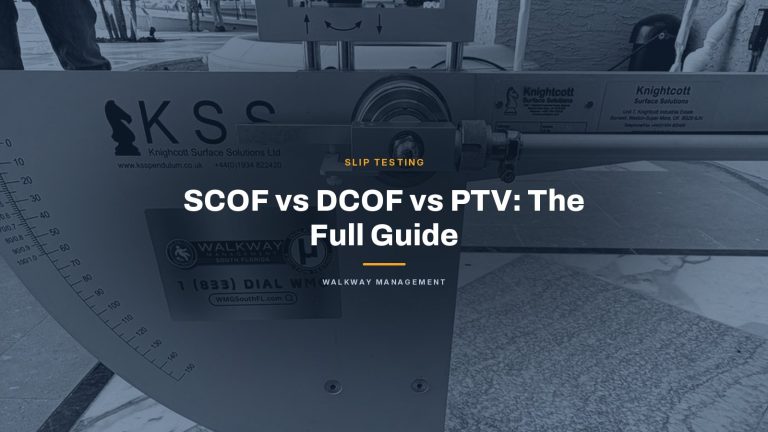
These are three different measurements on three different scales. You cannot convert between them. A PTV is not a DCOF with different units, and anyone who hands you a conversion chart is selling you something. We laid the differences out in detail in SCOF vs DCOF vs PTV.
The numbers people quote at you that are not requirements
Before the useful numbers, the ones that are not.
“OSHA requires 0.5.” OSHA does not. There is no OSHA standard that sets a numeric coefficient of friction for walking and working surfaces. The 0.5 figure came from a nonmandatory appendix to a 1990 rulemaking proposal that was never finalized, and OSHA itself said in a 2003 letter of interpretation that it does not have a standard mandating a particular coefficient of friction. If a supplier tells you their product “meets OSHA,” ask which section. There isn’t one.
“ADA requires 0.6, or 0.8 on ramps.” Those numbers appeared in Appendix A4.5 of the 1991 ADA Accessibility Guidelines, which was advisory guidance, not a requirement. The 2010 ADA Standards dropped them. The appendix itself noted that friction varies with contaminants and finishes outside the designer’s control and that compliance would be hard to measure on site, which was a fair observation then and still is.
Those two together are the source of most of the confusion in this trade. A proposed rule that died and an advisory appendix that was withdrawn have been quoted as law for thirty years.
ASTM C1028 was the horizontal dynamometer pull-meter test for static COF on tile. It was withdrawn in 2014. The problem was not the people using it, it was that the method could return a comfortable number for a floor that was genuinely dangerous once wet. We explained the mechanism in why C1028 was withdrawn. If a report on your desk cites C1028, it is citing a method that has not existed for over a decade.
ASTM D2047 is a real, current standard, and it gets misapplied constantly. It is a laboratory test using the James Machine, run dry, developed for polish-coated surfaces. It is the right test for the thing it was written for. It is not a field test, it is not a wet test, and a D2047 result does not tell you how your floor behaves when someone tracks in rain. We covered that distinction in where D2047 applies and where it doesn’t.
Why static measurements and drag sleds are the weak link
Here is the physics, without the jargon.
Static friction is the resistance to starting a slide from a dead stop. If you leave a rubber foot sitting on a wet floor for a few seconds, the liquid squeezes out of the contact area and the rubber settles into contact with the surface. Grip climbs while it sits there. This is called stiction, and it means a static test can report a high number that only exists because the test paused.
Nobody slips from a dead stop. People slip mid-stride, with the foot moving, with no time for the water to squeeze out. That is a dynamic event, and a static number does not describe it.
This is exactly why C1028 was withdrawn, and it is why static values on wet floors have a bad reputation with anyone who has watched them get tested in a deposition. The problem is not that the operator did anything wrong. It is that the measurement answers a question nobody asked.
Now, on drag sleds specifically, let me be more precise than the shorthand that gets passed around this trade, because the precision is what protects you.
The issue is not that every dragged instrument is worthless. The BOT-3000E is a dragged instrument and it is a legitimate, widely referenced tool. The issue is whether the instrument has been validated against known reference surfaces, and whether it is reporting a static or a dynamic value on a wet floor.
There is a standard for exactly this question. ASTM F2508 is the practice for validating walkway tribometers against reference surfaces whose relative slip potential was established through human subject walking trials. In plain terms: they had people walk on known surfaces, recorded what actually happened, and then asked whether the instrument agrees with reality. An instrument that has been through that has an answer when someone asks why it should be believed. An instrument that has not been through it is relying on the manufacturer’s word.
So the useful question is not “is it a sled.” The useful question is: is this device F2508 validated, is it reporting dynamic friction, and was it verified to be in working order on the day it was used. If the answer to any of those is no, the report built on it is fragile, and fragile is a bad thing to be standing on when you are a defendant. We compared the common instruments in different tribometers for slip resistance testing.
The numbers that do mean something
For a wet floor, these are the reference points worth knowing.
Under ANSI A326.3, hard surface flooring intended for level interior areas expected to be walked on when wet should measure a wet DCOF of 0.42 or greater. Interior wet-plus areas such as locker rooms and indoor pool surrounds go to 0.50. Exterior wet goes to 0.55, and so do areas where oils and greases are present. Those categories matter. A restaurant kitchen and a retail showroom are not held to the same figure. Our full breakdown is in DCOF requirements and the A326.3 minimums.
Under ANSI/NFSI B101.3, wet DCOF of 0.45 and above is high traction, 0.30 to 0.44 is acceptable, and below 0.30 is low.
For pendulum testing, a wet PTV of 36 or above is associated with low slip potential.
One caution that applies to every one of those figures. A floor that measures at or above a minimum is not a floor that has been certified safe, and no one in this trade should ever say otherwise. These are thresholds for product suitability and for comparison over time. Slip risk is a combination of the surface, the contamination, the cleaning regime, the footwear, the lighting, the walking speed, and the transitions. The number is evidence. It is not a verdict.
Which is also why we do not use words like slip-proof, non-slip, or guaranteed safe, and I would encourage you to strike them from your proposals. They are unprovable, and they will be read back to you slowly.
Polymer aggregates, and what the data sheet does not say
This is the part I expect the most argument about, so let me stick to what is documented.
Take the most common example. H&C SharkGrip is described by Sherwin-Williams as “a micronized polymer for addition to H&C coatings for slip resistance, fine texturing, and gloss reduction.” That is the manufacturer’s own language. It is a polymer bead product, and the beads are soft, rounded, and low density, which is what lets them stay suspended in a thin coating and what makes them comfortable underfoot. Those are real engineering advantages for barefoot areas, and I am not going to pretend otherwise.
Here is what to notice. The product literature states what it does in descriptive terms. It does not publish a slip resistance test value, and it does not cite ANSI A326.3, ASTM E303, or any other slip resistance test standard. There is no DCOF figure, no PTV, no test conditions.
So if you add it to a topcoat and then tell a commercial client the floor is slip resistant, trace where that claim came from. It did not come from a test. It came from a product name and a texture you can feel with your hand.
The material question compounds it. The two aggregates with the longest service records in commercial work are aluminum oxide and silica sand, and both are hard and angular. Aluminum oxide sits at 9 on the Mohs hardness scale and silica at about 7. Angular particles bite into a shoe sole and hard particles keep their edges under traffic. A polymer bead is neither hard nor angular. It is a smooth sphere of a soft material.
Both things follow from that. Rounded and soft is why it feels good on bare feet, and rounded and soft is why it wears and burnishes faster in a traffic lane than a mineral aggregate does. That is not a defect. It is the tradeoff the product was designed around. The mistake is treating a comfort-oriented additive as if it were a durability-oriented one, and then warranting the floor for five years.
There is a broader version of this point that applies to every additive, mineral ones included. Whatever texture you build into a coating is a wear item. It is highest on day one and it declines from there, fastest exactly where people walk most. Your promise, meanwhile, does not decline. If you told the client the floor was slip resistant, that sentence stays the same age forever.
And texture that you can see or feel is not the same as friction you can measure. A floor can look matte and read low. A floor can look glossy and read fine. I have measured both, more than once, and my hand has been wrong about which is which often enough that I stopped trusting it. If you would like a sense of what treatment actually moves the number, we covered that for a different substrate in anti-slip treatment on porcelain tile.
None of this means stop using polymer additives. It means: know what the additive was built for, ask the supplier for a test value under a named standard and named conditions, and if they cannot produce one, understand that you are the one holding the claim.
How the installer actually ends up in the lawsuit
Most people in this trade assume that once the job is accepted and paid for, a fall on that floor is the building owner’s problem. Usually the owner is the primary defendant. But there are well-established routes to the contractor, and they are worth understanding because they are not obvious.
The first is the doctrine of creating the hazard. In Espinal v. Melville Snow Contractors (98 N.Y.2d 136, 2002), New York’s highest court set out three situations where a contractor who has a contract with a property owner can still owe a duty to a member of the public they never contracted with. The one that matters here is the first: where the contractor, in failing to exercise reasonable care, “launched a force or instrument of harm.” Courts have read that to mean the contractor created or made worse a dangerous condition. The snow plow contractor in that case won, because plowing snow was held not to have created the hazard.
Now apply it. A snow plow removes something that was already there. Applying a coating to a floor is not that. You changed the surface. Whatever the floor’s friction was before you arrived, the friction afterward is a property of your material and your workmanship. That is a much shorter walk to “created the condition” than plowing snow ever was.
The second route is specific to Florida and it cuts both ways. Under Slavin v. Kay (108 So. 2d 462, Fla. 1958), a contractor is generally not liable to third parties for injuries occurring after the owner has accepted the work, if the defect was patent, meaning the owner knew about it or would have found it on reasonable inspection. Acceptance shifts that liability to the owner.
That sounds like good news, and for obvious defects it is. But the protection turns on the defect being discoverable. A floor that is only slippery when wet is close to the textbook definition of a latent condition. The owner walks the space at handover on a dry day. It looks right, it feels right, they sign. Nothing about a reasonable visual inspection would reveal that the wet friction is low. When a defect is latent, acceptance does not shift the liability, and the contractor’s original negligence can remain the proximate cause of an injury that happens later.
So the doctrine that protects Florida contractors from obvious defects offers the least protection for precisely this one.
The third route is the floor treatment line of cases. In Union v. Excel Commercial Maintenance (2020 NY Slip Op 03942), the Appellate Division restated the rule for products applied to floors: a defendant is not liable for applying wax, polish, or paint to a floor unless the defendant had actual, constructive, or imputed knowledge that the product could render the floor dangerously slippery. The court was equally clear in the other direction, that a floor merely being shiny or smooth does not by itself support a negligence claim.
Read that hinge again, because it is the most important sentence in this article. The defense is knowledge. Historically the contractor’s answer has been some version of: nobody told me, the industry did not test this, I used a product sold for the purpose and I applied it correctly. That has been a real and often successful answer.
Ask yourself how long it stays available.
Why the odds are moving, even though nothing has gone wrong for you yet
I understand the reasonable objection. Plenty of people in this trade have been coating floors for fifteen or twenty years, have never been sued, and have never had a client complain. That is real experience and it deserves respect.
It is also a statement about the past, and the two things that determine your future exposure are both moving.
The first is volume. Falls remain one of the largest injury categories in the country. CDC figures put the annual cost of falls at roughly $361 billion, with about 9 million emergency room visits, roughly 1 million hospitalizations, and about 44,000 deaths a year. Somewhere on the order of 65,000 slip and fall lawsuits are filed annually. On the occupational side, the Bureau of Labor Statistics counted 844 workers killed in falls, slips and trips in 2024, the second largest category of fatal work injury. Our fuller breakdown is on the slip and fall statistics page.
The second is the one that actually changes your position, and it gets much less attention. The standards are getting more specific, and specificity is what closes the ignorance defense.
ASTM Committee F13 on Pedestrian/Walkway Safety and Footwear has jurisdiction over the walkway standards and continues to develop them. ASTM F3132-20 is a practice for selecting walkway surfaces with pedestrian safety in mind, written for the design and specification stage, with the explicit goal of reducing the need to treat or replace slippery surfaces after they are installed. That standard exists to be pointed at during the part of the job you are involved in. ANSI A326.3 was revised in 2022 with situation-specific minimums rather than one blanket number. ASTM F2508 gives everyone a way to ask whether an instrument deserves to be believed. The American Floor Safety Alliance publishes FS101-2025 for pendulum testing, and I should disclose plainly that I founded AFSA, so treat that as an interested reference rather than a neutral one.
Put those together and the trend is not subtle. Every year there is more published, more specific, more citable guidance about how a walkway surface should be selected, measured, and verified. Every year “there was no way to know” becomes a slightly harder sentence to say under oath.
That is the honest version of why the past twenty years do not predict the next ten. Not because anyone is coming for contractors. Because the knowledge that the Union v. Excel rule hangs on is becoming general knowledge in this trade, and once it is general, it is imputed.
What to actually do about it
None of this requires you to become a testing company. It requires a record.
Stop selling an adjective and start selling a number. “Slip resistant” means nothing on its own. “Wet DCOF measured at 0.58 under ANSI A326.3 on completion, tested at four locations” means something specific, and it is defensible because it is true and it is documented.
Test the floor when you finish, on commercial work where the client cares about slip resistance. This is the single highest-value thing in the article. A completion test does two jobs. It tells you whether the system you just installed actually performs the way you assumed it does, which is worth knowing for your own sake across every future job you quote. And it creates a dated, third-party record of the floor’s condition on the day you handed it over. If someone falls in year three, the argument becomes what happened to the floor since, rather than what the contractor failed to do.
Match the number to the room. A 0.42 floor is not the right answer for a pool deck or a commercial kitchen. Know which A326.3 category the space falls into before you pick the system, not after.
Get the maintenance instructions in writing and hand them over. A large share of the floors I test have been changed by the cleaning more than by the traffic. The wrong product, the wrong dilution, or a residue that never gets rinsed will move a floor’s wet friction. If you documented the required cleaning regime at handover and it was not followed, that is a materially different conversation. There is practical detail on this in how to clean a floor to keep it safe.
Ask suppliers for a test value under a named standard. Not a marketing claim, not a product name with “grip” in it. A value, a standard designation, the wet or dry condition, and the surface it was measured on. Some will produce it. The ones who cannot have just told you something useful.
Keep the records. The test report, the product data sheets, the mix ratios, the maintenance instructions you handed over, and the signed acceptance. Three years from now, that folder is the difference between a defense and a shrug.
Never write slip-proof, non-slip, or guaranteed safe. No floor is any of those things, and every one of those words is a promise you cannot keep.
Where we fit
We test floors. That is the whole business. We are not a coatings company and we do not compete with you for the installation, which is exactly why a number from us is worth more to you than a number you generate yourself. An independent test is evidence. A contractor’s own assessment of their own work is an opinion, and it gets treated as one.
For installers, the useful services are a completion test on a finished commercial floor, giving you and the client a documented wet DCOF or PTV at handover, and a pre-specification test where a client is asking for a performance level and you want to know whether the system you are planning can actually deliver it before you sign something that says it will. We travel for this work nationally.
If you have a floor you have been quietly unsure about, that is the one to test first. You can reach us through the contact page, and I am happy to answer method questions from people in the trade whether or not there is a job attached to it. The trade getting more precise about this is good for everyone in it, including the people who never hire us.
This article is informational and describes slip resistance measurement practice and general legal doctrine. It is not legal advice, and it does not create an attorney-client or expert relationship. Court decisions discussed here are from specific jurisdictions and specific facts; how any doctrine applies to your work depends on your state and your circumstances. Consult your own attorney and your insurance carrier about your exposure. FS101-2025 is published by the American Floor Safety Alliance, which our founder established.