
Exhibit · The Deliverable
Most reports hand you a number.
Ours hands you evidence.
A slip-resistance reading is only worth what its documentation can defend. Every Walkway audit is built as a tamper-evident engineering record — pendulum PTV and BOT-3000E DCOF, tied to locations, conditions and the governing standard — the kind of report built to hold up when a claim lands on your desk.
The strength of the report
A number is only as strong as the report behind it.
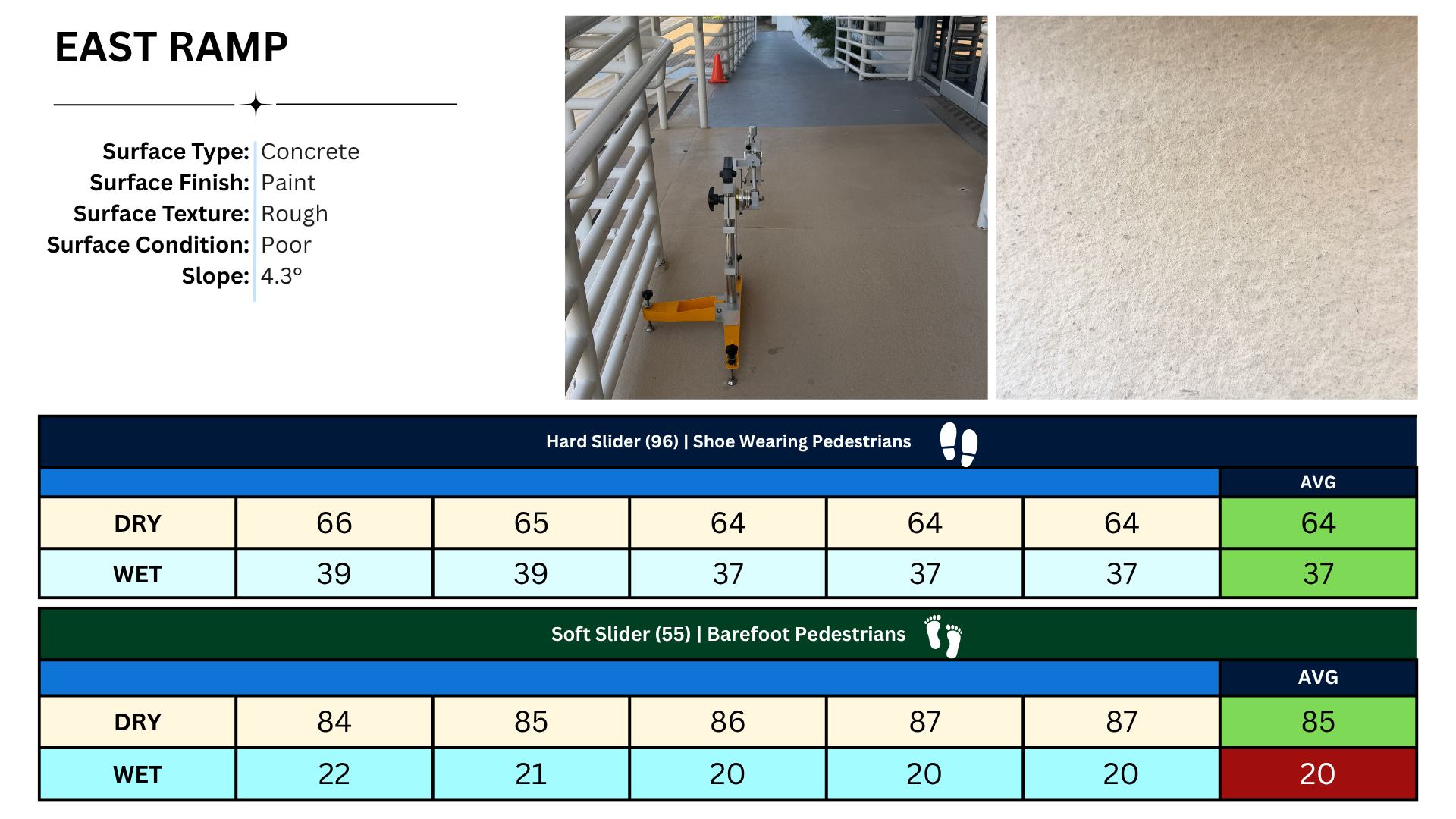
Every location in a Walkway audit is worked up the way this one is: the surface identified, its condition and slope recorded, the Pendulum Slip Tester photographed in place, and readings taken both ways — hard slider for people in shoes, soft slider for barefoot — dry and wet, then averaged. The result isn’t a claim. It’s the end of a visible, repeatable trail an opposing expert can follow and still not break.
Anatomy of the report
Eleven things a defensible report proves.
- Scope, site map and locations tested
- Instruments, serials and calibration dates
- Test method, wet conditions and solution
- Pendulum PTV — the slip-risk reference
- BOT-3000E DCOF vs the A326.3 threshold
- Per-location results, keyed to photos
- Photographic record of every surface
- Interpretation against the applicable standard
- Stated limitations and test conditions
- Chain of custody and verification record
- Signed conclusion you can hand to counsel
Built with StepAPP
Tamper-evident by design.
SlipIntel has partnered with StepAPP, the reporting platform from Safe Space Ingenuity built to generate thorough BOT-3000E records. Every reading is captured at the instrument and locked into a traceable digital record — instrument, calibration, conditions, raw runs and a verification code, all sealed together.
That traceability is the point. It means the value printed in your report is provably the value the tribometer produced, which is exactly what preempts a data-manipulation challenge before it starts. See how that plays out in Litigation From the Inside.
Why it stands up
Built to the standards that support admissibility.
Every audit follows best industry practices for reporting slip resistance test results — the framework set out in ASTM F2048-00 — is composed in accordance with ASTM F1694 for walkway investigation and incident report forms, and is built to support admissibility under the Daubert standard for expert evidence.
| Standard / principle | What it governs |
|---|---|
| ASTM F2048-00 | Best practice for reporting slip-resistance test results |
| ASTM F1694 | How a walkway investigation and incident report is composed |
| Daubert standard | The admissibility of expert scientific evidence in court |
Get documentation that protects you.
Request an audit, or build a standing testing program so the record is always current before you need it.
This page describes our reporting practice in general terms. It isn’t legal advice — for how the rules of evidence apply to your matter, talk with a licensed attorney.