The Spec Said Slip Resistant. Nobody Measured It.
By Walkway Management South Florida
Somewhere in the specification for your last commercial job, the words “slip resistant” appear. Maybe on the pool deck. Maybe the lobby, the kitchen, the entry, the ramp, the restroom.
Now go find the number attached to it.
On most Florida jobs there isn’t one. The architect wrote the words, the GC passed them down, the sub installed a product the supplier called slip resistant, the inspector signed off, and everyone moved on. Nobody measured anything, because nothing in the process asked anyone to.
Here is the part worth sitting with. Not measuring does not make the number go away. It means the number gets chosen later, by someone else, under worse conditions. Three years after handover, after a person falls, by an expert the plaintiff hired, with an instrument, in a deposition, in a room where nobody is on your side.
This is written for Florida GCs and subs. It is informational, not legal advice. I test floors for a living. I am not your attorney, and how any of this lands on a specific job depends on your contract and your facts.
Florida’s code gives you an adjective, not a number
Start with what the code actually says, because most people in this trade have never read the line.
The Florida Building Code, on public pool decks, says at §454.1.3.1.1 that pool wet decks “shall be constructed of concrete or other nonabsorbent material having a smooth slip-resistant finish.” §454.1.3.1.5 says the same for walkways.
Then it defines the term. Slip resistant means “having a textured surface which is not conducive to slipping under contact of bare feet unlike glazed tile or masonry terrazzo and nontextured plastic materials.”
Read that definition again. It is a description of a texture, compared against three example materials. There is no test method in it. There is no value in it. There is no wet condition specified, no instrument, no pass mark. It is a qualitative standard, and two competent people can look at the same deck and disagree in perfectly good faith about whether it meets it.
Compare that to the model code. The 2024 International Swimming Pool and Spa Code, at §306.2, requires deck, ramp, coping and similar step surfaces to be slip resistant and cleanable, and then says that where such surfaces are evaluated for slip resistance, they must achieve, when tested wet, a minimum pendulum classification of P4 under AS 4586, or a minimum DCOF of 0.42 under ANSI A326.3. It also puts the choice of appropriate classification on the design professional, based on surface type, environment and traffic.
That is what a quantified requirement looks like. A condition, a method, a value, and a named party who decides.
The gap between those two is where your exposure lives. Florida hands you a word. The measurable version of that word exists, it is written down in the model code, and it is available to anyone who wants to apply it to your finished job after the fact. You just were not the one who applied it.
What is actually being measured
Quickly, because you need enough of this to ask the right question, not to run the test yourself.
Friction between shoe and floor is what keeps a person upright. Walking puts the heel down at an angle, and the floor has to supply enough grip to stop that foot sliding forward. When the available friction is less than the gait demands at that instant, the person goes down.
The number changes with what is on the floor. A dense, smooth, hard surface that grips perfectly well dry can lose most of its usable friction under a film of water, because the water has nowhere to go and the shoe rides on it. This is why “it passed inspection” and “she slipped on it” are not contradictory statements. Inspection looked at it dry, with eyes.
Three measurements are in circulation and they are not interchangeable.
Pendulum testing, ASTM E303-22, swings a weighted rubber slider across the wet surface and reports a Pendulum Test Value, or PTV. It is our reference method, it is a field instrument, and it measures the floor in the building in the condition it is actually in. A wet PTV of 36 or above is associated with low slip potential.
Dynamic coefficient of friction, ANSI A326.3, drags a standardized sensor across the wet floor at controlled speed and reports a DCOF. It is what most product specs and code references point to, and its real strength is comparison and monitoring: this area against that one, before treatment against after. A single DCOF value does not by itself predict whether a given person will slip, and the standard says so in its own text.
Static coefficient of friction, or SCOF, measures resistance to starting a slide from a dead stop. Treat this family with care, for reasons in the next section.
These sit on three different scales. You cannot convert between them. If a supplier hands you a conversion chart, that is a sales document, not a technical one. We set the differences out in SCOF vs DCOF vs PTV.
Under ANSI A326.3 the wet DCOF minimum depends on the space. Interior wet is 0.42. Interior wet plus, which covers locker rooms and indoor pool surrounds, is 0.50. Exterior wet is 0.55, and so is anywhere oils and greases are present. A kitchen and a showroom are not held to the same figure, which is exactly the kind of distinction a blanket “slip resistant” in a spec erases. The full breakdown is in DCOF requirements and the A326.3 minimums.
One caution that matters more for you than for anyone. A floor that measures above a minimum has not been certified safe, and you should never write or repeat that it has. These are thresholds for product suitability and for comparison over time. The number is evidence. It is not a verdict, and it is not a warranty.
The numbers that get quoted at you and are not requirements
“OSHA requires 0.5.” It does not. No OSHA standard sets a numeric coefficient of friction for walking and working surfaces. That figure came from a nonmandatory appendix to a 1990 rulemaking proposal that was never finalized, and OSHA said as much in a 2003 letter of interpretation. When a supplier says their product “meets OSHA,” ask which section. There isn’t one.
“ADA requires 0.6, or 0.8 on ramps.” Those appeared in Appendix A4.5 of the 1991 ADA Accessibility Guidelines as advisory guidance, not requirements, and the 2010 ADA Standards dropped them.
“It passed ASTM C1028.” C1028 was withdrawn in 2014. It could return a comfortable number for a floor that was genuinely dangerous once wet. A submittal citing it is citing a method that has not existed for over a decade, and we covered why in why C1028 was withdrawn.
“We have a D2047 result.” ASTM D2047 is real and current and gets misapplied constantly. It is a laboratory test on the James Machine, run dry, developed for polish-coated surfaces. It is not a field test and it is not a wet test.
The common thread is static measurement. Static friction is resistance to starting a slide from a stop, and if a rubber foot sits on a wet floor for a few seconds the liquid squeezes out and grip climbs while it sits. Nobody slips from a dead stop. People slip mid-stride, with no time for that to happen. A static number on a wet floor answers a question nobody asked, which is why the method that relied on it was withdrawn.
On dragged instruments generally, be more precise than the shorthand you will hear. The issue is not that every sled is worthless, since the BOT-3000E is a dragged instrument and a legitimate one. The issue is validation. ASTM F2508 is the practice for validating walkway tribometers against reference surfaces whose slip potential was established through human subject walking trials. So the question to ask about any report on your desk is whether the device was F2508 validated, whether it reported dynamic rather than static friction, and whether it was calibrated that day. We compared the instruments in different tribometers for slip resistance testing.
Slavin, and why it protects you least on exactly this
Most contractors know the general shape of the rule: once the owner accepts the work, injuries after that are the owner’s problem. That comes from Slavin v. Kay, 108 So. 2d 462 (Fla. 1958), and it is still good law in Florida.
The rule has a condition on it that decides everything here. A contractor is generally not liable to third parties for injuries occurring after the owner accepted the work if the defect was patent, meaning the owner knew about it or would have discovered it on reasonable inspection. Acceptance of patently defective work shifts that liability to the owner.
Acceptance of latently defective work does not. Where a defect is not discoverable and was not in fact discovered, the contractor’s original negligence can remain the proximate cause of an injury that happens well after handover.
So ask the question that matters. Is a floor with inadequate wet slip resistance patent or latent?
The owner walks the space at handover. It is a dry day, the floor is clean, it is brand new, it looks exactly like the sample. They sign. Nothing about a reasonable visual inspection would reveal that the wet friction is low, because wet friction is not visible, and the one condition that would expose it is the one condition nobody creates during a walkthrough.
That is close to a textbook latent condition, and it means the doctrine Florida contractors rely on offers the least protection on precisely this defect. The thing that makes a slippery-when-wet floor dangerous is the same thing that stops acceptance from getting you off the hook: you cannot see it.
There is a corollary worth noticing, and it points the other way. A defect becomes patent when it is discoverable. A test report is a document that makes a condition discoverable. Measuring the floor and handing the owner the number changes the character of what they accepted. I am not going to tell you that converts every case, because that depends on facts and on your lawyer. But the direction it moves is obvious, and it costs a fraction of what the argument costs.
Four Florida-specific things that decide who pays
Non-delegable duties. A general contractor has statutory and common law duties to the owner that it cannot delegate to a sub and walk away from. Handing the flooring scope to a sub does not hand over the GC’s own exposure for defects in it. If the finished floor does not perform, the GC is in the conversation regardless of who held the trowel.
Your indemnity clause may be void. This one surprises people. Under Fla. Stat. §725.06, an indemnification provision in a construction contract is void and unenforceable unless it contains a monetary limitation on the extent of the indemnification that bears a reasonable relationship to the contract, and that limitation has to be part of the project specifications or bid documents. Where the owner is a party, the limit generally cannot be less than $1 million per occurrence unless the parties agree otherwise. Plenty of flow-down clauses in circulation do not comply. If your plan for slip resistance exposure is “the sub indemnifies us,” go read the actual clause before you rely on it, and have your attorney tell you whether it survives §725.06.
Chapter 558 runs on a clock, and it runs on records. Florida’s Notice and Opportunity to Repair Act requires an owner to serve a written notice of claim describing the alleged defects in reasonable detail before filing suit, generally at least 60 days ahead, or 120 days where an association representing more than 20 parcels is involved. Once that notice lands, a contractor has 30 days to inspect, 10 days to forward copies to each contractor, sub, supplier or design professional it reasonably believes responsible for each specified defect, and 45 days to serve a written response that either disputes the claim or offers to repair or pay.
Look at what those deadlines assume. To forward the notice to the right sub within 10 days, and to specify which defect you believe they own, you need to already know what the floor measured and who installed what. If the only record is a submittal that says the product is slip resistant, you cannot allocate anything. You will spend the response window trying to reconstruct a fact that a single test at substantial completion would have preserved.
The exposure window is seven years, not ten. Senate Bill 360, effective April 13, 2023, shortened Florida’s statute of repose for actions founded on the design, planning or construction of an improvement to real property from ten years to seven, and changed how the commencement date is determined. The four-year statute of limitations was not changed. Whether a particular injury claim falls under that repose provision or is treated as ordinary negligence is fact-specific, and it is a question for your attorney rather than for me.
Take the seven years as a records instruction rather than a comfort. It tells you how long the folder needs to survive, and seven years is longer than most project files last on most contractors’ servers.
Where this actually bites on Florida jobs
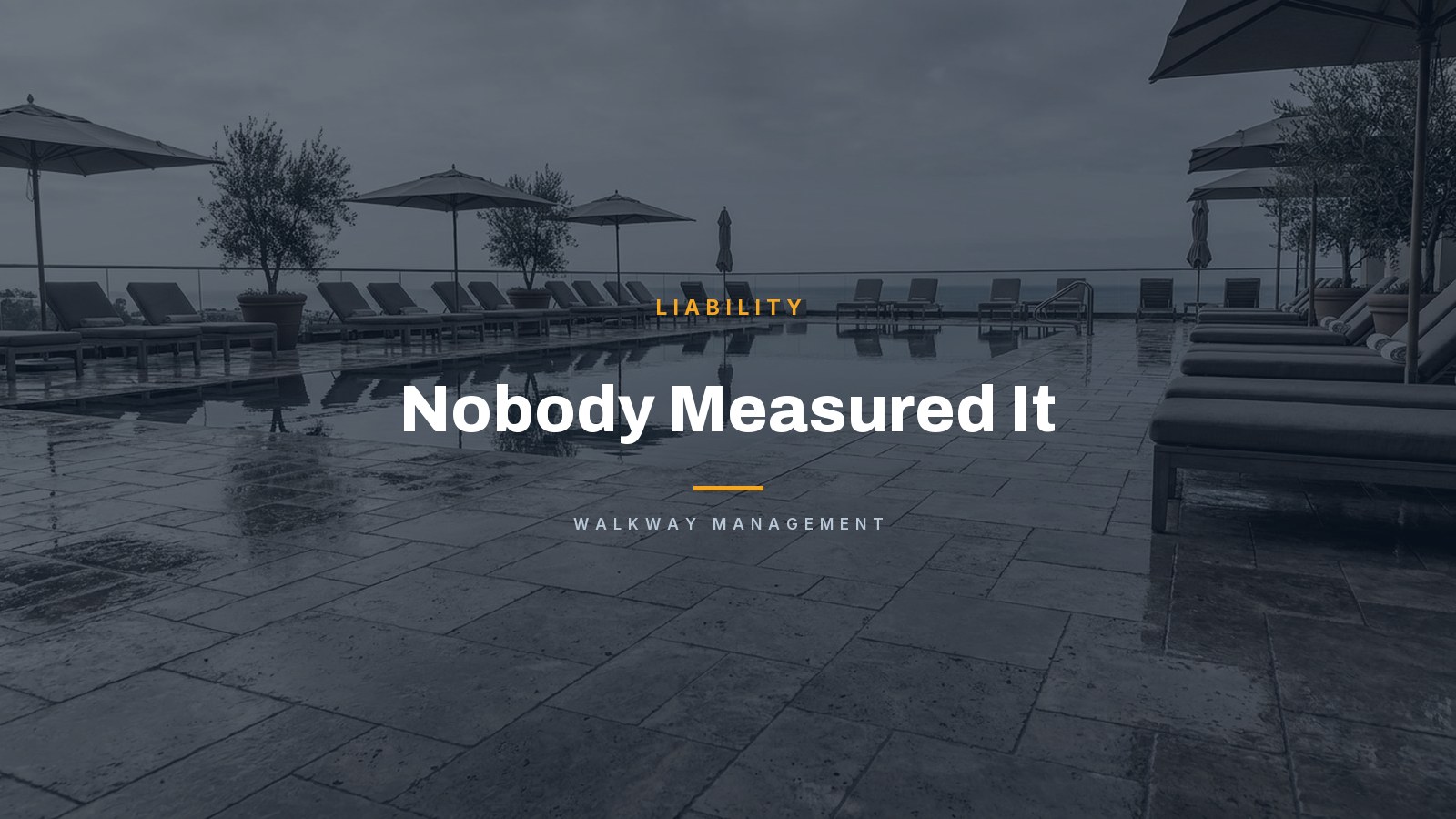
Pool decks and the wet walkways around them, which is where the code language above applies directly and where bare feet and standing water are guaranteed rather than possible.
Entries and transitions, particularly the first ten feet inside a door during a summer afternoon. Rainwater arrives on shoes, and the floor that was specified for the lobby was usually specified for how the lobby looks.
Polished concrete and terrazzo in lobbies and corridors. Both can be excellent floors. Both are dense and smooth by design, and the finishing decisions that make them look the way the architect wanted also determine how they behave wet.
Commercial kitchens and back-of-house, where the relevant A326.3 category is the oils and greases one at 0.55, not the 0.42 that gets quoted as though it were universal.
Restrooms, locker rooms and any indoor wet area, which fall in the 0.50 category.
Exterior walkways, ramps and stair treads, where the surface is wet on a schedule set by the weather.
And a note for the subs reading this. If your scope includes an anti-slip additive in a coating, find out what test value the manufacturer publishes for it. Some publish nothing at all. A common one, H&C SharkGrip, is described by Sherwin-Williams as “a micronized polymer for addition to H&C coatings for slip resistance, fine texturing, and gloss reduction,” and the literature gives no DCOF, no PTV, and no test standard. That does not make it a bad product for the barefoot areas it suits. It does mean that if you or the GC told the owner the floor was slip resistant, that claim came from a product name rather than a measurement, and the polymer beads are soft and rounded where aluminum oxide and silica are hard and angular, so the texture that is there on day one is a wear item in a traffic lane.
What to do differently on the next job
Put a number in the spec, or make the design professional put one there. “Slip resistant” is not a specification, it is a wish. “Wet DCOF of 0.55 or greater under ANSI A326.3, verified on the installed surface at substantial completion” is a specification. It tells the sub what to buy, it tells you what to check, and it gives everyone the same target instead of three different assumptions.
Match the number to the room. 0.42 interior wet, 0.50 interior wet plus, 0.55 exterior wet and anywhere oils or greases are present. One blanket figure across a whole building is the wrong answer in both directions.
Test the installed surface at substantial completion, not the sample. A manufacturer’s lab value describes a tile in a laboratory. It does not describe your floor after the grind, the seal, the coating, the cure, and the final clean. What people walk on is the assembly, and the assembly is what should be measured.
Hand the number to the owner in writing, and keep proof you did. This is the Slavin point in practical form, it is the Chapter 558 point in practical form, and it is the cheapest of everything on this list.
Hand over the maintenance requirements too. A large share of the floors I test have been changed more by the cleaning than by the traffic. Wrong product, wrong dilution, or a residue that never gets rinsed will move a floor’s wet friction. If the required regime was documented at handover and not followed, that is a materially different conversation. There is practical detail in how to clean a floor to keep it safe.
Read your indemnity clause against §725.06 now, while nothing has happened, rather than discovering it is unenforceable in the middle of a claim.
Keep the folder for seven years. Test report, submittals, product data sheets, the maintenance documents you handed over, and the signed acceptance.
Never write slip-proof, non-slip, or guaranteed safe into a spec, a submittal, a warranty, or a marketing sheet. No floor is any of those things, and each of those words is a promise that will be read back to you slowly.
Where we fit
We test floors, and that is the entire business. We do not install, we do not sell coatings, and we are not bidding against anyone on your job, which is the reason our number is worth something to you. An independent test is evidence. A contractor’s assessment of their own work is an opinion, and it gets treated as one.
For GCs and subs the useful work is a substantial completion test that documents wet DCOF or PTV on the installed surface at handover, a pre-specification test when someone is asking for a performance level and you want to know whether the assembly you are planning can actually hit it before you sign, and a post-incident test when a claim has already landed. We work throughout Florida and travel nationally.
If there is a floor on a finished job that you have been quietly unsure about, that is the one to test first. You can reach us through the contact page, and I am glad to answer method questions from people in the trade whether or not there is a job attached. On the standards side, the American Floor Safety Alliance publishes FS101-2025 for pendulum testing, and I should disclose plainly that I founded AFSA, so treat that as an interested reference rather than a neutral one.
This article is informational and describes slip resistance measurement practice, code language, and general legal doctrine. It is not legal advice, and it does not create an attorney-client or expert relationship. Code provisions are cited by edition and section and may be amended; verify the edition in force for your jurisdiction and permit date. How any statute or doctrine applies to your work depends on your contract and your facts. Consult your own attorney and your insurance carrier about your exposure. FS101-2025 is published by the American Floor Safety Alliance, which our founder established.