Slip Resistance and ASTM F2772: What It Means for Athletic Flooring Safety
When you design or specify athletic flooring, slip resistance sits alongside shock absorption and ball bounce as a property you have to get right. Get it wrong and players slide or catch a foot. For multi-purpose indoor sports floors, ASTM F2772 is the specification most people work from.
Here is what it says about slip resistance, and where you still have to use your own judgment.
What Is ASTM F2772?
ASTM F2772 is the Standard Specification for Athletic Performance Properties of Indoor Sports Floor Systems. It sets performance targets for sports floors in gyms, courts, and recreation centers. It covers more than bounce and shock absorption. One of the properties it defines is surface finish effect, which is the standard’s term for slip resistance.
ASTM F2772 measures four performance properties:
-
Force Reduction (Shock Absorption)
-
Surface Finish Effect (Slip Resistance)
-
Ball Rebound
-
Vertical Deformation
All four matter. For safety, surface finish effect is the one that most directly affects whether someone falls.
Slip Resistance in ASTM F2772: “Surface Finish Effect”
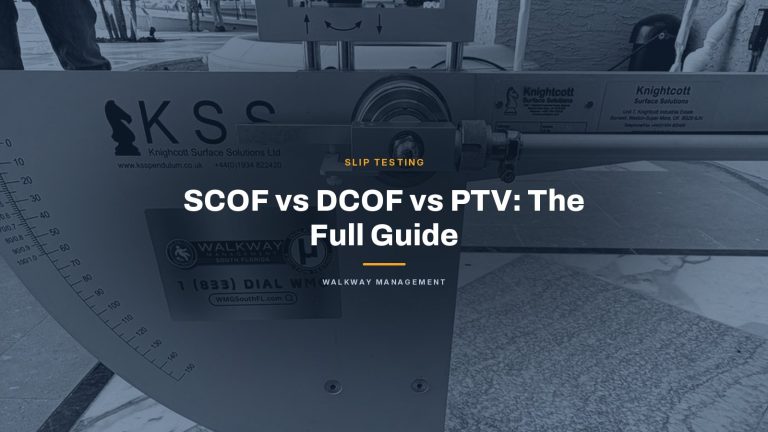
The standard measures slip resistance with the Pendulum Slip Tester, following ASTM E303. We think that is the right call. The pendulum swings a rubber slider across the floor to make a fast, moving contact, which is close to what happens at the moment a foot starts to slip. A static coefficient-of-friction test does not capture that. It measures resistance while nothing is moving, and people do not slip while standing still.
Key criteria include:
-
Performance level: The floor must achieve a dry test value between 80 and 110 BPN (the pendulum test value).
-
Uniformity: No individual test value can deviate more than 4 BPN from the average across test points.
These numbers tie to how a shoe grips the floor during real movement, whether that is a pivot in basketball or a sprint on an indoor track. Below the range, the floor is too slick and players lose their footing. Above it, the floor grips too hard and more of the load goes into knees and ankles.
Why It Matters (and What You Should Watch For)
Most sports floors are designed and rated dry. In use they rarely stay that way. Courts pick up sweat, and ventilation is often poor. A small spill or a wet patch near a doorway can drop the friction on a floor that tested fine dry. The dry rating does not tell you how the floor behaves wet, and wet is where most falls happen.
A few things to check:
-
Test with the pendulum: Use the Pendulum Slip Tester rather than a static SCOF test.
-
Target the right range: Stay inside the 80–110 BPN window. Below 80 the floor is too slick. Above 110 it grips hard enough to strain knees and ankles.
-
Check surface consistency: The floor should read the same across its whole surface. Big swings in grip from one spot to another are a hazard on their own, which is why the standard caps the variation at 4 BPN.
Final Word
ASTM F2772 is not perfect, but it gets one important thing right: it measures slip resistance with the pendulum instead of a static COF test. That puts it ahead of several U.S. standards that still rely on static numbers.
If you install, maintain, or specify indoor athletic flooring, treat slip resistance as a real requirement. Ask for Pendulum Slip Tester data. Check the uniformity across the floor. And keep one thing in mind: meeting a sports-floor specification is not the same as knowing the floor is safe in the conditions people actually use it in. A dry rating does not answer a wet question, so test for the conditions you expect.
Need your gym floor tested? We can help.
Get a free quote or call 1-833-DIAL-WMG to have your floors tested.