35 and 45: The Closest Thing America Has to Pendulum Guidance
By Walkway Management South Florida
ASTM E303-22 tells you how to run a Pendulum Slip Tester. It covers the slider, the swing, the wetting, the reading. What it does not tell you, because a test method never does, is what the number ought to be.
That gap is the most common question I get after a pendulum job. The floor read 31. Is that a problem? The standard that produced the 31 has no opinion.
Most of the answers in circulation are British or Australian. The UK Slip Resistance Group and the Health and Safety Executive are where the familiar low-slip threshold comes from. Those are good sources and I use them. They are also, plainly, not American.
There is one American document that answered the question directly. It is an endorsement published by the Slip Resistance Committee of the Ceramic Tile Institute of America, and as far as I can find it remains the only US-published guidance that puts specific minimum pendulum numbers against specific floor types.
It is also about twenty-four years old, almost nobody cites it, and the organization that wrote it no longer exists.
What CTIOA actually endorsed
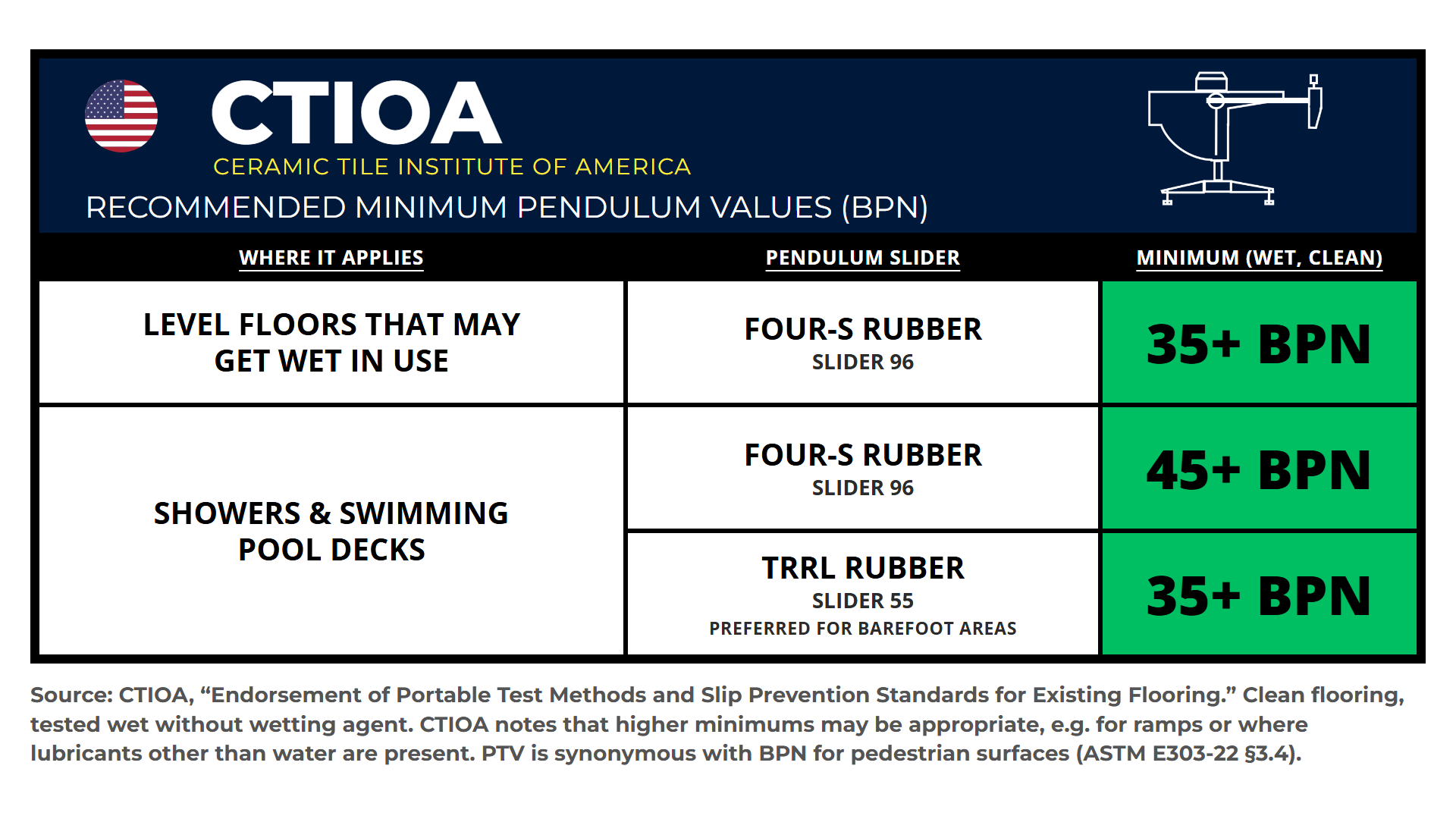
The pendulum values, taken from the Safety Standards section of the endorsement, on clean flooring, tested wet, with no wetting agent:
| Where it applies | Slider | Minimum |
|---|---|---|
| Level floors that may get wet in use | Four-S rubber | BPN 35 |
| Showers and swimming pool decks | Four-S rubber | BPN 45 |
| Showers and pool decks, barefoot areas | TRRL rubber | BPN 35 |
On the barefoot line the endorsement is specific about why: “for barefoot areas pendulum testing with TRRL rubber as specified in Ref. 3 is preferable, and for showers and pool decks the BPN with TRRL rubber should be 35 or higher. Softer than Four-S rubber, TRRL rubber better simulates bare feet.”
Two points of vocabulary, because this document comes from an earlier era of the field. CTIOA writes BPN, the British Pendulum Number, which is the unit ASTM E303 defines. The UK and Australian literature, and our own reports, now more often say PTV, the Pendulum Test Value. On a pedestrian surface with a pedestrian slider these are the same number on the same scale. Nothing converts and nothing is rescaled.
The endorsement also declines to treat these as ceilings. “Higher slip resistance minimums may be appropriate in many situations, such as ramps, environments where lubricants other than water are present, etc.”
Why this counts as the closest thing to national guidance
Look at what else exists in the United States and the gap becomes obvious.
ASTM E303-22 is a test method. It standardizes the instrument and the procedure and sets no acceptance criteria, which is correct behavior for a test method and unhelpful if you are holding a number and a question.
ANSI A326.3 does set minimums, and they are incorporated by reference into the model codes, but they are dynamic coefficient of friction values produced by a dragged sensor. They say nothing about a pendulum reading, and A326.3’s numbers cannot be carried across to a pendulum scale.
ASTM F2508 answers whether an instrument deserves belief. It does not tell you what a passing value is.
The NFSI B101 series works in DCOF and SCOF, not pendulum values.
So a person running a pendulum in the United States, asked in a deposition where their threshold comes from, has historically had to answer “the United Kingdom.” That answer holds up on the science and lands awkwardly in an American courtroom, and it is the specific awkwardness this CTIOA document resolves.
One more current American source deserves naming. The American Floor Safety Alliance publishes FS101-2025 for pendulum testing, and I should disclose plainly that I founded AFSA, so treat that as an interested reference rather than a neutral one. CTIOA carried no such problem. It was an independent trade institute with no stake in my business, and since it no longer exists it will never acquire one. That independence is most of why I keep pointing at it.
The line that matters most in a dispute
This is the passage I cite more than any other, and it appears twice. In the Summary: “On level flooring, in case of conflict between Tortus and pendulum findings, preference is for the pendulum.”
Then again, at length, in the body:
In litigation it may sometimes occur that there is a conflict between findings from the pendulum and the Tortus regarding whether flooring was safe when wet. In such cases we recommend that the pendulum take precedence. This is because of its acceptance by the United Kingdom Slip Group and Standards Australia/Standards New Zealand after extensive study. In the absence of pendulum results, we recommend acceptance of Tortus data.
An American trade institute, writing about American floors, anticipating the exact situation where two portable instruments disagree in front of a judge, and naming which one should win.
I want to be careful about what that does and does not establish. CTIOA was not a court and not a code body. The passage carries the weight of a considered recommendation and no more than that. But when the question is which instrument a reasonable practitioner should have trusted, having an independent American body on record is worth considerably more than having nothing.
The endorsement is equally clear about where the pendulum’s advantage lies. It recommends the pendulum “in locations where some pedestrians (either adults or children) may reasonably be expected to be running rather than walking,” then names them: airport concourses, subway, bus and railroad stations, lobby areas where doors stand open during rainfall, swimming pools used by children.
The physical reason is speed. The document puts the pendulum’s slider at eight miles per hour, “about 200 times faster than the movement of the Tortus slider,” and observes that this is “close to that of a typical young adult’s body when running at a sustainable pace.” The slower instrument’s speed is “typical of the speed of a person’s heel when it first lightly touches down in normal walking.”
Two instruments, two different moments in a human gait. Neither is wrong. They answer different questions, and the endorsement says so.
They set a validation bar ten years before ASTM did
This is the part that impressed me most on a careful read, and it is almost never mentioned.
Alongside endorsing the pendulum, CTIOA published the evidence standard any portable method has to meet: a correlation coefficient R of 0.90 or higher against human traction measured by the variable-angle ramp method, on a population of at least fourteen samples “well-distributed over the ramp test categories R9 through R 13.”
That is a validation requirement anchored to people actually walking, with a numeric bar, a minimum sample size, and a spread requirement. It also stays open to future instruments, explicitly: “This endorsement does not preclude use of other existing or improved portable test methods as long as they demonstrate a correlation coefficient R of 0.90 or higher.”
ASTM F2508, the practice that formalized validating walkway tribometers against reference surfaces derived from human subject walking trials, was first published in 2011. CTIOA set its bar roughly a decade earlier.
The endorsement also records the correlations it relied on: both methods above R 0.90 against the ramp, both above R 0.93 against the SATRA STM 603 shoe-based machine, and R 0.94 between pendulum and Tortus across seventeen ceramic tile samples.
And they called C1028’s retirement about twelve years early
One sentence, easy to miss: “These portable tests are intended to replace the horizontal pull-meter test, American Society for Testing and Materials Method C 1028-96, that U.S. ceramic tile manufacturers currently use for field testing of their products.”
ASTM withdrew C1028 in 2014. CTIOA said it needed replacing in 2002 and named the methods that should replace it. We covered why it eventually went in why C1028 was withdrawn.
The same section is just as direct about a drag-instrument threshold then in common use, calling the traditional 0.40 minimum “too low” and saying it “leads to passing grades for unsafe floors.”
On not mixing the scales
The endorsement carries its own warning against the thing I spend most of my time correcting, and it is worth quoting because it comes from a tile institute rather than from me.
Different test methods yield different numerical results for the same sample, even if the test results are all converted to coefficients of friction.
It then works an example: a sample reading 0.60 on the high-speed pendulum with Four-S rubber, which it equates to a BPN of 55, reads approximately 0.80 on the low-speed drag instrument with the same rubber. The conclusion it draws is the right one: “This means that safety standards must depend on the test method that is used.”
That is why the pendulum numbers in this article sit in their own table, and why the drag-instrument numbers in the endorsement, which are 0.50 for level wet floors and 0.70 for wet barefoot areas, are not interchangeable with them. Different instrument, different scale, different threshold. We set the distinctions out in SCOF vs DCOF vs PTV.
Read it carefully, because it has rough edges
Two things anyone citing this document should know, both found by reading it against itself.
The Summary undersells the shower and pool numbers. The Summary near the front lists only two pendulum values: 35 with Four-S for level floors, and 35 with TRRL for showers and pool decks. The Safety Standards section in the body adds a third, the 45 with Four-S for showers and pool decks. Cite the Summary alone and you will understate the shod requirement for wet barefoot areas by ten points. The body is the fuller statement, and it is what the table above follows.
There is a unit typo in the body. The Safety Standards section describes drag-instrument measurement paths as “20 centimeters (3 inches).” Twenty centimeters is about eight inches, and both the Summary and the method section correctly say 20 cm (8 inches). A transcription slip rather than a technical dispute, but it is the sort of thing that gets repeated once somebody quotes the wrong line.
The honest case against leaning on it
I have spent this article arguing the document matters. Here is the strongest argument that it should not carry as much weight as I am giving it.
CTIOA was a trade institute, not an accredited standards developer. This is an endorsement approved by a committee. It did not go through an ANSI consensus process, it carries no ANSI designation, and it was never adopted into a building code. On a formal hierarchy of authority it sits well below ANSI A326.3, and anybody claiming otherwise is overreaching.
It is old, and its references show it. Internal dating places it in 2002: the companion new-flooring endorsement is dated 19 September 2001, and this document asks manufacturers to supply pendulum data by 1 June 2003. It cites ASTM E303-93(1998), now E303-22. It cites C1028-96, withdrawn. It cites AS/NZS 4586:1999, long since revised, and an ISO draft. Every normative reference in it has moved.
The numbers are not originally American. CTIOA says so itself: “Following the lead of the United Kingdom Slip Group and Standards Australia/Standards New Zealand, we recommend a minimum British Pendulum Number (BPN) of 35.” This is an American endorsement of criteria developed elsewhere, which is a real and useful thing, but it is not an independent American derivation.
Nobody can ever revise it. ASTM and ANSI documents get reaffirmed, amended, or withdrawn by the committees that own them. This one has no committee left. Whatever it got right in 2002 is frozen there, and so is whatever it got wrong, which is the real cost of the publisher closing.
And the headline figure has drifted by a point. CTIOA endorsed 35 for level wet floors, following the UK guidance as it stood in 2002. The UK low-slip-potential threshold most commonly quoted now is 36. One point is not a scientific disagreement, but if you cite 35 and an opposing expert cites 36, you want to know exactly why both numbers exist rather than discovering it on the stand.
Taken together those four points set the document’s real standing: the best American answer available to a question no American standards body has answered since.
How I use it
I do not treat CTIOA as a pass mark. No single friction value from any method establishes that a floor is safe, and a number clearing 35 on a level floor tells you the floor cleared 35 on the day it was measured, under the slider and the contaminant used.
What I do with it is narrower and more useful. When a client or an attorney asks where an American practitioner is supposed to get a pendulum threshold, this is the document I hand them, alongside the UK and Australian sources it draws on. When two instruments disagree about the same floor, I point at the precedence language and explain the speed argument underneath it. And when someone asks why a pool deck should be held higher than a lobby, the 45 and the reasoning behind it are already written down by somebody other than me.
For a field this short of American guidance, a twenty-four-year-old endorsement from a tile institute is a thinner foundation than it should be. It is also the one we have, and it is better than most people realize.
Read it yourself
I would rather you did not take my summary for it. The endorsement runs nine pages, it is written in plain language, and anyone who tests or specifies floors should read the Safety Standards section at minimum.
There is a complication worth knowing, and it is the reason this section exists. CTIOA is no longer an active organization. Its website, ctioa.org, no longer reaches the institute and the domain now redirects to a GoDaddy sale listing. Its nonprofit registration has gone quiet as well: the GuideStar profile for the entity carries the note that it “has not appeared on the IRS Business Master File in a number of months” and “may have merged with another organization or ceased operations.”
So the only American guidance of its kind now survives entirely through copies held by other people, with no publisher standing behind it. That is a thin thread for a document this useful.
So we keep one here, unaltered and as published by the Slip Resistance Committee of the Ceramic Tile Institute of America:
View and download the CTIOA endorsement (PDF, 9 pages)
If you represent CTIOA or a successor organization and would prefer this hosted differently, write to us and we will follow your preference.
This article is informational and describes slip resistance measurement practice and published guidance. It is not legal advice. The CTIOA endorsement is a trade association document, not an American National Standard or a building code requirement, and standards cited within it may have been revised since it was written. Quotations are taken from the full text of the CTIOA Slip Resistance Committee’s “Endorsement of Portable Test Methods and Slip Prevention Standards for Existing Flooring.” FS101-2025 is published by the American Floor Safety Alliance, which our founder established. No single friction value, from any method, establishes that a floor is safe.