Different Tribometers for Slip Resistance Testing
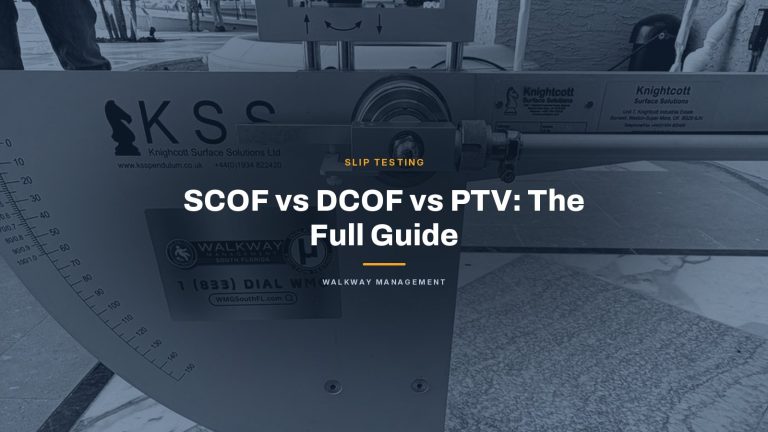
Pendulum Slip Tester
- Slip Resistance Test Methods: ASTM E303-22, EN 16165, AS 4663, and others. Endorsed by the Ceramic Tile Institute of America (CTIOA).
- Validation for Pedestrian Traction: Validated by Greater London Council Bulletins 43 (1971) and 145 (1985), in continuous use since 1971, and adopted by over 50 nations.
- Measures: The Pendulum measures what is called a “Pendulum Test Value” (PTV). This measurement gives you a good understanding regarding the risk of a slip on the surface.
- Use: Primary standard for floor slip resistance testing in 50 nations, including E303-22 floor and road slip resistance testing and Sustainable Slip Resistance testing. The International Swimming Pool and Spa Code recently included the Pendulum Slip Tester as one of two accepted methods for testing slip resistance!
- For more information click here!

BOT-3000E
- Precision DCOF Measurement: Captures friction values with high accuracy using standardized test protocols.
- Durable Design: Built for repeated use in commercial environments with minimal maintenance.
- Data Management: Generates standardized reports for documentation, quality assurance, and audit trails.
- Application Scope: Ideal for lab-based and field-based assessments of interior hard flooring, particularly in dry or wet flat surfaces.
- User-Friendly Interface: Digital controls and intuitive menus make operation efficient for certified technicians.
- Compliance-Driven: Officially recognized in ANSI A326.3 for classifying hard surface flooring materials; referenced in the International Swimming Pool and Spa Code alongside the Pendulum Slip Tester.
While the BOT-3000E is a trusted tool for monitoring flooring performance and verifying classification, it should be paired with real-world testing methods, like the Pendulum Slip Tester (ASTM E303), when assessing actual slip risk in diverse environments.

SlipAlert (iAlert Slip Meter)
- Slip Resistance Test Method: Proprietary product with a published British standard. Endorsed in the 2024 version of the United Kingdom’s Slip Resistance Group’s “The Assessment of Floor Slip Resistance” and mentioned in the latest European standard BS EN 16165:2021.
- Validation for Pedestrian Traction: Validated by studies from British and Australian government agencies comparing SlipAlert to the pendulum.
- Advantages: Smaller, lighter, simpler, more rugged, and less costly than the pendulum.
- Drawbacks: Requires a long path length. The cart may veer, bounce, or spin, necessitating repeated runs.
- Use: Suitable where the pendulum is not economical. Rapid monitoring by minimally trained staff and visual demonstrations.

Horizontal Pull-Meter
- What it fixed: The 825A slip meter addresses issues with size, weight, and the large Neolite pad’s adhesion problems. Evolved to adapt to various environments.
- Standards: Designed to meet ANSI/NFSI B101.1-2009 standards for accurate and reliable slip resistance measurements. This device was created to be able to test with the ASTM C1028 Standard (which has been withdrawn since 2014).
- Advanced Technology: The 825A is a rugged horizontal pull-meter we use when a job specifically calls for a static (SCOF) reading.

Tortus III
- Slip Resistance Test Method: Proprietary product, endorsed by the Ceramic Tile Institute of America (CTIOA).
- Validation for Pedestrian Traction: University of Southern California Medical Center study (Tortus II) published in J. Forensic Sci. March 2007.
- Advantages: Provides printed records, cost-effective for multiple points on a property, and can test short, narrow samples if needed.
- Drawbacks: May not assess hydroplaning potential for running individuals.
- Use: Periodic monitoring, both dry and wet, using hard and soft rubber test feet.

English XL (VIT)
- Origins and Development: Developed in the early 1990s by William English. Designed to measure pedestrian slip resistance.
- Small and Portable: Compact and easy to transport. Powered by a gas burst instead of gravity.
- Variable Incidence Tribometer (VIT): Applies force to the flooring surface to recreate the force of a human foot. Test foot cylinder contacts the surface in a heel-first manner, similar to human walking.

Brungraber Mark IIIB
- The Slip-Test Mark IIIB is a completely re-engineered update of Dr. Robert Brungraber’s original research-proven Mark II / Mark III design.
- Heavy-duty billet aluminum construction.
- Weighs only 10 pounds.
- Sturdy case fits in an airplane overhead compartment.
- No batteries or CO2 required.
- Conforms to ASTM F2508.

Get a free quote or call 1-833-DIAL-WMG to have your floors tested.