Aquatic Play Equipment Slip Resistance Testing: What ASTM F2461-26 Requires
By Walkway Management South Florida
For years, the ASTM standard governing splash pads and other aquatic play equipment said surfaces had to be “slip resistant,” full stop. No test method, no number, no way for a facility owner or a manufacturer to actually check. ASTM’s newly revised F2461-26 closes that gap. It names a specific instrument, a specific test condition, and a specific pass mark, and aquatic play equipment slip resistance testing now has a real standard behind it instead of a phrase anyone could claim.
South Florida is about as dense in the surfaces this covers as anywhere in the country: resort splash pads, HOA and condo pool play areas, water-park standing surfaces, and launch pools where kids step in wet and barefoot. Hurricane season keeps these amenities wet and heavily used for half the year, and rainy-season afternoons do the rest. A standard that finally says how to check these surfaces is worth understanding in plain terms.
What ASTM F2461-26 Changed
According to ASTM’s own announcement of the revision, F2461-26 now requires wet, barefoot testing with the British Pendulum Tester, with results reported in BPN (British Pendulum Number) and matched against AS 4586-2013’s P4 classification. That replaces a standard that previously offered no measurement method at all for this equipment category.
It’s a narrow, specific change, and it’s worth being precise about what it covers. F2461 governs aquatic play equipment itself, structures like splash pad features, spray elements, and water-play apparatus, not every pool deck or walkway in South Florida. But the method it adopts, wet barefoot pendulum testing against a P4 benchmark, is the same approach already used on the broader surfaces around that equipment, which is exactly why it’s useful to understand here.
Pendulum testing is well suited to exactly this kind of surface. The method mechanically replicates a heel strike at walking speed on a wet surface, which is the moment most real slips actually happen, and it’s the reason ASTM E303, the standard behind the British Pendulum Tester, is the gold standard for assessing wet slip resistance in the first place.
Which South Florida Surfaces This Actually Touches
In practice, that covers the standing and stepping surfaces built into or immediately around the play structure itself: splash pad feature pads and spray zones, water-play apparatus decks, wading-pool entry areas, and launch pools at water slides. HOA and condo clubhouse splash pads, resort kids’-pool water features, municipal splash parks, and water-park standing areas are all common South Florida installations that fall under this category. Hurricane season runs roughly June through November, and rainy-season afternoon storms are a near-daily fact of life outside it, so these surfaces spend most of the year wet, barefoot, and in heavy use.
How a Pendulum Test Actually Works
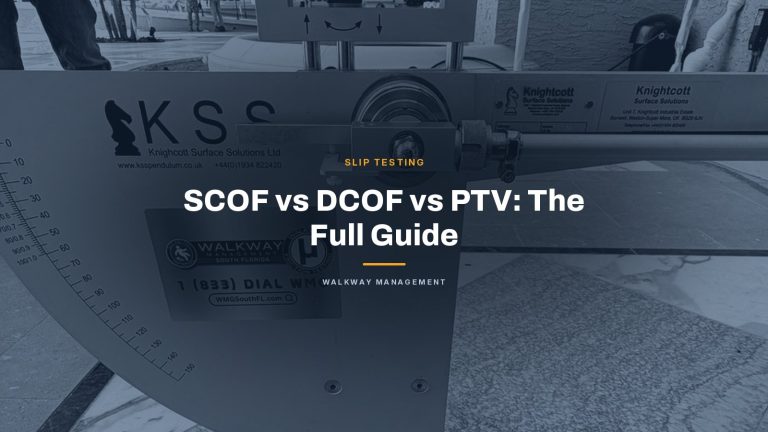
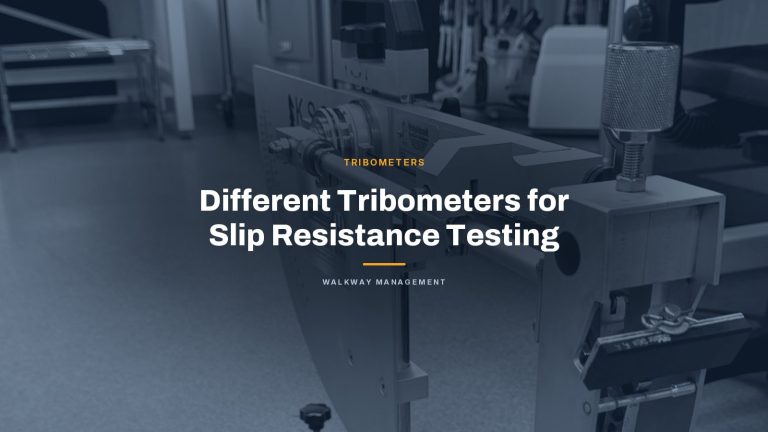
The British Pendulum Tester, standardized under ASTM E303, works by swinging a spring-loaded rubber slider across a wetted test surface and measuring how much energy the friction between slider and surface drags out of the swing. The slider is mounted on an arm with a nominal spring load of about 2,500 grams, released from a locked position, and swept across roughly 125 millimeters of contact path. Five swings are recorded for each location, after two unrecorded conditioning swings. The result reads out as a British Pendulum Number, called a Pendulum Test Value in the pedestrian-surface world, on a 0 to 150 scale.
What makes the pendulum method suited to this kind of surface is the rubber slider itself. The standard specifies two slider compounds: a harder “4S” rubber that simulates a shod shoe sole, and a softer rubber, commonly called the TRL or Slider 55 compound, built to simulate bare skin. For a splash pad or pool deck where people are standing and walking barefoot on a wet surface, the barefoot slider is the one that actually represents the hazard.
What a P4 Classification Means in Real Numbers
AS 4586-2013, the Australian standard F2461-26 references for its pass mark, classifies wet pendulum results into bands from P0 (most slippery) to P5 (least slippery). P4 requires a wet pendulum Slip Resistance Value of 45 to 54 when tested with the harder, shod-simulating slider, or 40 to 44 with the softer, barefoot-simulating slider. Those two numbers aren’t interchangeable results for the same surface; they’re two different test conditions reported against two different bands of the same table, which is exactly why a test report needs to say which slider was used.
P4 isn’t an arbitrary pick, either. AS 4586’s own guidance table lists P4 as the recommended wet pendulum classification for swimming pool surrounds and communal shower rooms, with P5, the strictest band, reserved for pool ramps and stairs leading into the water. A splash pad or water-play surface sitting barefoot, wet, and in near-constant use fits squarely in that same category of risk.
What a Defensible Pendulum Test Report Should Document
ASTM E303 doesn’t just set the test procedure; it also sets what a report built on that procedure has to include. A proper pendulum test report records the individual BPN or PTV reading from each swing, not just an average, along with whether the test was run wet or dry, the temperature of the test surface at the time, and the type, age, condition, texture, and location of the surface tested. It also records which slider rubber was used and its hardness, which, given the barefoot-versus-shod difference covered above, is the detail that determines which P4 band a result actually has to clear. A report missing any of that can still carry an accurate number, but it leaves out the context a facility manager, an insurer, or an inspector checking it against F2461-26 would need to trust it.
Where South Florida Already Sees This Threshold
This isn’t the first time a wet PTV of 45 and AS 4586’s P4 classification have shown up together in a code that applies here. The International Swimming Pool and Spa Code’s 2024 edition, Section 306.2, sets pool deck slip resistance at a wet PTV of 45 or higher (AS 4586 class P4), or alternatively a wet DCOF of 0.55 or higher for exterior, wet-rated surfaces. F2461-26 is applying a number that’s already load-bearing in a pool code South Florida facilities are built to, not inventing a new one.
A Related Standard, a Different Instrument
Worth noting separately: NFSI’s B101.4, published in 2023, also addresses wet barefoot surfaces, including pool decks, bathtubs, showers, and splash park areas, but through a different test method entirely. B101.4 measures wet Dynamic Coefficient of Friction with a tribometer, not a pendulum, and sets its own bands: 0.60 or higher is High Traction with low slip probability, 0.40 to 0.59 is Moderate, and below 0.39 is Low Traction with high slip probability. Both standards are measuring the same underlying hazard, a bare, wet foot on a hard surface, through two different, legitimate instruments. A facility owner working through aquatic surface compliance may reasonably encounter both.
What This Means for Aquatic Play Equipment Slip Resistance Testing Going Forward
For South Florida property owners, HOAs, and resort operators with splash pads, pool play structures, or water-park features, F2461-26 gives aquatic play equipment slip resistance testing an actual benchmark to document against: wet pendulum testing with the barefoot-simulating slider, reported in BPN, meeting AS 4586’s P4 classification or better. Pool decks around that equipment are already expected to meet roughly that same bar under codes like the ISPSC. F2461-26 simply writes the number directly into the equipment standard itself.
If you manage or build out a splash pad, resort pool play area, or water-park feature in South Florida, we can test it against that mark and give you a documented, defensible answer before a hurricane-season rush of barefoot traffic finds out for you. Request a slip resistance test or quote from Walkway Management South Florida at wmgsouthfl.com.