You Sealed It. Now You Own the Slip.
What slip resistance actually is, why “I added grit” won’t save you in court, and the one piece of paper that will.
A freshly sealed paver deck with a deep wet-look finish is a beautiful thing. Here’s what doesn’t make the before-and-after photos: the glossier and smoother you make it, the better the odds it puts somebody on their back the first time it rains. And when that happens on a commercial job, the lawyer doesn’t only call the property owner. He pulls the invoice with the sealing contractor’s name on it.
I test floors for a living and I sit as an expert witness in slip-and-fall cases, for both sides. So I want to walk you through what slip resistance really is, where the aggregate you’re mixing into your sealer actually lands on the scale, and the cheap, boring document that keeps your name off a lawsuit.
Dry grip and wet grip are two different animals
A floor that grips fine dry can be an ice rink wet, and it’s not bad luck. It’s physics.
When a heel hits a wet surface, the water underneath has to get out of the way in a few thousandths of a second. On a rough surface, the little peaks and valleys act like drainage channels and punch through the water so rubber still touches stone. On a smooth surface, the water can’t escape fast enough, so it stays trapped and lifts the foot right off the floor. Tribologists call it the squeeze-film effect. You’ve felt it every time you hydroplaned a truck.
Now think about what a film-forming, wet-look sealer does. It lays a smooth plastic skin over the paver and fills in the exact micro-texture that used to drain the water away. That’s why the honest field rule is: most sealed surfaces pass when they’re dry and fail, or sit right on the borderline, when they’re wet. The condition that hurts people is the one your gloss coat is worst at.
Penetrating sealers that soak in and leave no film don’t have this problem the same way. Topical, glossy, wet-look finishes are where the risk lives.
The number that matters outside is the pendulum
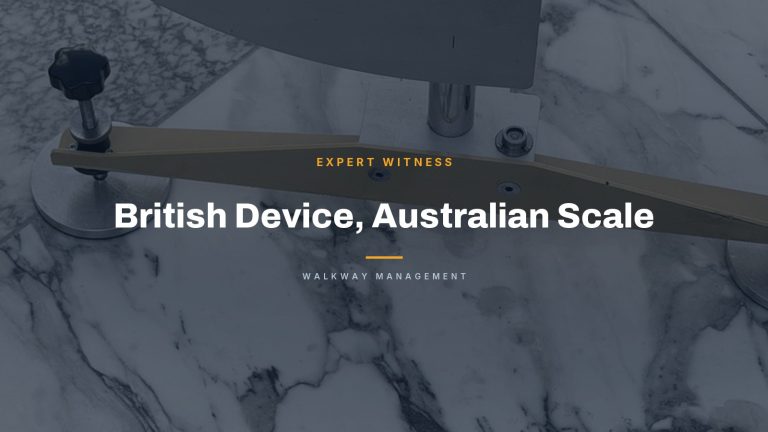
If you want to know how a finished exterior surface behaves wet, the right tool is the pendulum slip test (ASTM E303, and the FS101 standard published by the American Floor Safety Alliance, which I founded). A weighted rubber slider swings down and strikes the floor the way a heel does at the instant of a slip, and it actually recreates that squeeze-film. A slow drag-sled can’t do that, which is why the pendulum is the wet-and-outdoor tool used in fifty-plus countries.
It reports a Pendulum Test Value (PTV), tested wet. Rough bands: 0 to 24 is high slip potential, 25 to 35 is moderate, 36 and up is low, and external walkways generally want somewhere around 45. There’s also the tile industry’s number, ANSI A326.3 dynamic coefficient of friction (DCOF). Note the threshold everyone quotes, 0.42, is the interior wet minimum. The exterior wet minimum in the 2022 version is 0.55. Different spot, different bar.
Two things I’ll beg you to remember, because they’re where installers get talked in circles:
- PTV, DCOF, and the old SCOF are different measurements from different machines. Nobody can validly “convert” one into the other, no matter what a slick conversion chart claims. They don’t translate.
- No single number certifies a floor as “safe.” The A326.3 standard says so on its own first page: the test does not predict whether a person will or won’t slip. A number tells you a surface met a lab threshold under set conditions. It is evidence, not a legal force field. Don’t let a product rep sell you (or you sell your client) “0.6, guaranteed safe.”
The aggregate trap: Shark Grip is plastic, and plastic is the weakest grip you can buy
Here’s the unpopular part.
Pull the Safety Data Sheet on H&C Shark Grip. Section 3 lists it as 100% polypropylene. It’s a soft plastic bead, roughly Mohs 2 (a fingernail scratches it), micronized to 60 mesh. Most of the other “clear” additives are the same family: Seal-Krete’s non-slip additive, RAE SharkSkin, the generic “polybeads.” Soft, round, light plastic.
Now put that next to aluminum oxide, which runs Mohs 9, one of the hardest things you can put in a coating. Here’s the kicker: even the companies that sell these additives rank the plastic dead last. One supplier’s own comparison rates aluminum oxide “very high” for slip resistance, silica sand “moderate to high,” and the polymer beads only “mild to moderate,” and flat-out says the plastic is “not recommended for heavy-duty commercial or industrial applications.” That’s not me talking. That’s the vendor.
Why does the plastic come up short?
- A soft, round bead has low friction wet and polishes smoother under traffic instead of staying sharp. Aluminum oxide is hard and angular, so it keeps cutting through the water film for years.
- Polymer beads are light and buoyant — the whole selling point is they “stay suspended” in the sealer. The flip side of buoyant is that in a thick glossy topcoat the bead can migrate up and get buried under the film, so the foot ends up riding on smooth sealer, not on the grit you paid for.
None of that makes Shark Grip useless. It’s fine for a barefoot-friendly residential pool deck where people want smooth-feeling, low-abrasion texture. But on a commercial floor that’s going to get wet and see real traffic, a soft plastic bead is the wrong tool, and reaching for it because it’s clear and easy is how you end up under-built on the exact job most likely to sue you.
“I added grit” is not “it tests safe” — and a real case proves it
This is the part that actually decides these cases.
In Faiella v. Oradell Construction Co. (New York, 2019), a walkway was coated with epoxy paint and then a clear sealant. A few days later someone slipped on it and sued the contractor and the coating sub. Her theory was exactly the one we’ve been talking about: they should have added grit to make it slip-resistant.
The contractors won that case. But read why they won: the injured side showed up with no friction testing and no qualified expert, just a lawyer’s say-so that it was too slick, and the court threw it out because slip resistance is not something you can eyeball. Now flip it around. If that plaintiff had walked in with a wet pendulum number showing the finished walkway failed, this is a completely different case, and it’s the contractor sweating. These cases live and die on whether somebody has a real slip-resistance measurement. The side holding the number wins.
You want to be the side holding the number.
“They accepted the job” is not the force field you think it is
A lot of guys believe that once the owner signs off and pays, it’s their problem. Careful.
Here in Florida, the Slavin doctrine does say a contractor is generally off the hook after the owner accepts the work — but only for defects the owner could reasonably see (patent defects). A floor that looks great and grips fine dry, then turns slick wet, is a hidden defect. That’s the exact category the shield does not cover, which leaves the door open to come back at the contractor.
Other states have gone further and scrapped the “acceptance ends your liability” idea altogether. Indiana did it in Peters v. Forster (2004), holding an installer can be liable to someone who gets hurt even after the owner accepted the work, as long as the injury was foreseeable. And courts routinely hold that a contractor who “launches a force or instrument of harm,” meaning they make a surface dangerous, owes a duty to the person who gets hurt (Espinal v. Melville Snow Contractors, NY 2002; Union v. Excel Commercial Maintenance, NY 2020). Translation: finishing the job and getting paid does not automatically make a slip somebody else’s problem.
When you say “slip-resistant,” you just wrote a warranty
And it’s not only negligence you’re exposed to. The moment you put “slip-resistant” or “non-slip” in a proposal, a text message, or on your website, that’s an express representation your commercial client is buying. If the finished floor doesn’t live up to it, that’s a breach-of-warranty path that doesn’t even require proving you were careless. It only requires showing the surface didn’t do what you promised.
So either stop making absolute promises, or be ready to back them with a number.
How to actually cover yourself
None of this means don’t seal, or don’t add traction. It means close the gap between “I added grit” and “it actually tests safe wet.” Here’s the short version:
- Test the finished, in-service surface, wet. Not the bare paver, not the sealer in the can. The version that hurts people is the version you measure.
- Get it done independently and documented. A third-party report with the date, the surface, the method, and the wet number is a piece of paper that says “on this day, this floor measured this.” That’s the document that ends the argument, or keeps you out of it entirely. That’s the whole point of an independent slip-resistance test: it turns “he said it was slippery” into a measurement with your date stamp on it.
- Kill the absolute language. Don’t promise “non-slip.” Say what’s true: “we can add traction and verify it with a wet slip test,” or hand the client the tested value and the standard it met.
- Match the aggregate to the job. Commercial, wet, real traffic? A hard, angular aggregate over a soft plastic bead, and then verify it. Verify beats hope every time.
The test is your receipt
You already protect yourself with contracts and insurance. A wet slip test on the finished surface is the same species of protection, and it’s cheap and fast. It’s the one thing that converts “the floor he sealed was slippery” into “here’s the number, measured the day we finished, to the standard.” The glossy finish is the easy part. Don’t hand a lawyer your reputation because you trusted a bag of plastic beads.
I’m Claudius Nan. I founded Walkway Management South Florida, an independent slip-resistance testing firm, and the American Floor Safety Alliance (AFSA), which publishes the FS101 pendulum standard referenced above. I also serve as an expert witness in slip-and-fall cases, for plaintiffs and defense. Full disclosure: I run a commercial floor-testing service, so I have skin in the “get it tested” game. This piece is general information for contractors, not legal advice, and it isn’t about any specific case. If you’re staring at a commercial job and wondering whether your finish will hold up wet, that’s precisely the question an independent test answers.
Sources: H&C Shark Grip Safety Data Sheet (Sherwin-Williams), Exterior Performance Coatings aggregate comparison; ASTM E303-22 and AFSA FS101-25 (pendulum / PTV); ANSI A326.3-2022 (wet DCOF minimums); TCNA DCOF guidance; Faiella v. Oradell Construction Co., 171 A.D.3d 1013 (N.Y. App. Div. 2d Dep’t 2019); Peters v. Forster, 804 N.E.2d 736 (Ind. 2004); Espinal v. Melville Snow Contractors, 98 N.Y.2d 136 (2002); Union v. Excel Commercial Maintenance, 185 A.D.3d 869 (N.Y. App. Div. 2d Dep’t 2020); Slavin v. Kay, 108 So. 2d 462 (Fla. 1959).