
Pendulum Slip Tester · ASTM E303-22 · PTV
It hits the floor
at the speed you do.
The Pendulum Slip Tester is our reference method for real, wet, in-motion slip risk. Its slider strikes the floor at about the speed of a walking heel — which is why it reads the surfaces a slow, flat-footed tribometer can miss, and why it sits behind fifty years of published slip research and the pool-deck requirement in ISPSC 2024.
Why the pendulum sees more
Measured at the speed a slip actually happens.
A heel lands at roughly 10 km/h. The pendulum slider strikes at the same speed, so it captures the thin, pressurised water film that makes a wet floor dangerous. A drag sled crawls across about fourteen times slower and can push that water aside — reading a smooth wet floor as safer than a real foot would find it. It is why DCOF is a compliance and monitoring tool, and the pendulum is the reference for slip risk.
Why PTV matters
A number you can map to real fall risk.
Decades of UK HSE/BRE research link PTV to slip probability: a wet reading of 36 or higher corresponds to a low slip potential, on the order of one slip in a million steps under worst-case conditions. That mapping is what turns a friction reading into a risk decision.
- Outdoor surfaces, ramps, and textured finishes
- Pool decks and aquatic facilities (ISPSC 2024 references at least AS 4586 P4 or a wet DCOF of 0.42 (ANSI A326.3), with the design professional selecting the class)
- International specs: BS EN 16165, BS 7976, AS 4586
- AFSA FS101-2025 — the American Floor Safety Alliance’s pendulum method (free download). AFSA was founded by our principal, Claudius Nan.
- Sports surfaces and stadium walkways
The wet PTV scale and its risk bands. An example reading of 54 sits well inside low slip potential.
How the Pendulum Slip Tester works
A weighted arm carrying a rubber slider swings down and sweeps across the wet test surface. The friction the surface exerts on the slider robs the arm of energy, and how far the arm rises on the far side, read off a calibrated scale, gives the Pendulum Test Value. More friction means a lower swing and a higher PTV.
The arm is released from horizontal and swings down through the wet surface.
The rubber slider sweeps the floor at about heel-strike speed, so the test reflects a real, wet, in-motion foot.
Friction robs the swing of energy; the arm rises less on the far side.
The drag pointer reads the Pendulum Test Value off the calibrated scale — higher PTV, more grip.
Because the slider mimics the way a shoe heel contacts a floor, and because the test is done wet, PTV reflects real-world, wet, in-motion slip risk, especially on the textured and outdoor surfaces a flat-footed tribometer struggles to sit on.
Why we call it the Pendulum Slip Tester
You may have heard this instrument called the “British Pendulum.” It earned that nickname because the modern version was refined in the UK, but the name is misleading, because it suggests a device that only applies over there. It doesn’t. The pendulum measures slip resistance across the United States, the UK, Europe and Australia, it sits behind more than fifty years of published slip research, and it is the method national and international standards reach for when the question is real, wet, in-motion slip risk. Calling it “British” is a little like saying french fries belong only in France. So we call it what it is: the Pendulum Slip Tester.
Why we still run DCOF alongside it
The pendulum is our reference method for real-world wet slip risk, and it is what we recommend first. We pair it with DCOF because U.S. specifications for interior hard flooring are written around ANSI A326.3, so a DCOF number is what documents compliance. The two answer different questions: PTV tells you how the floor behaves under a real heel strike, DCOF documents the U.S. standard. In litigation, running both removes any argument that the wrong instrument was used. It is our standard, not an upsell.
From the field
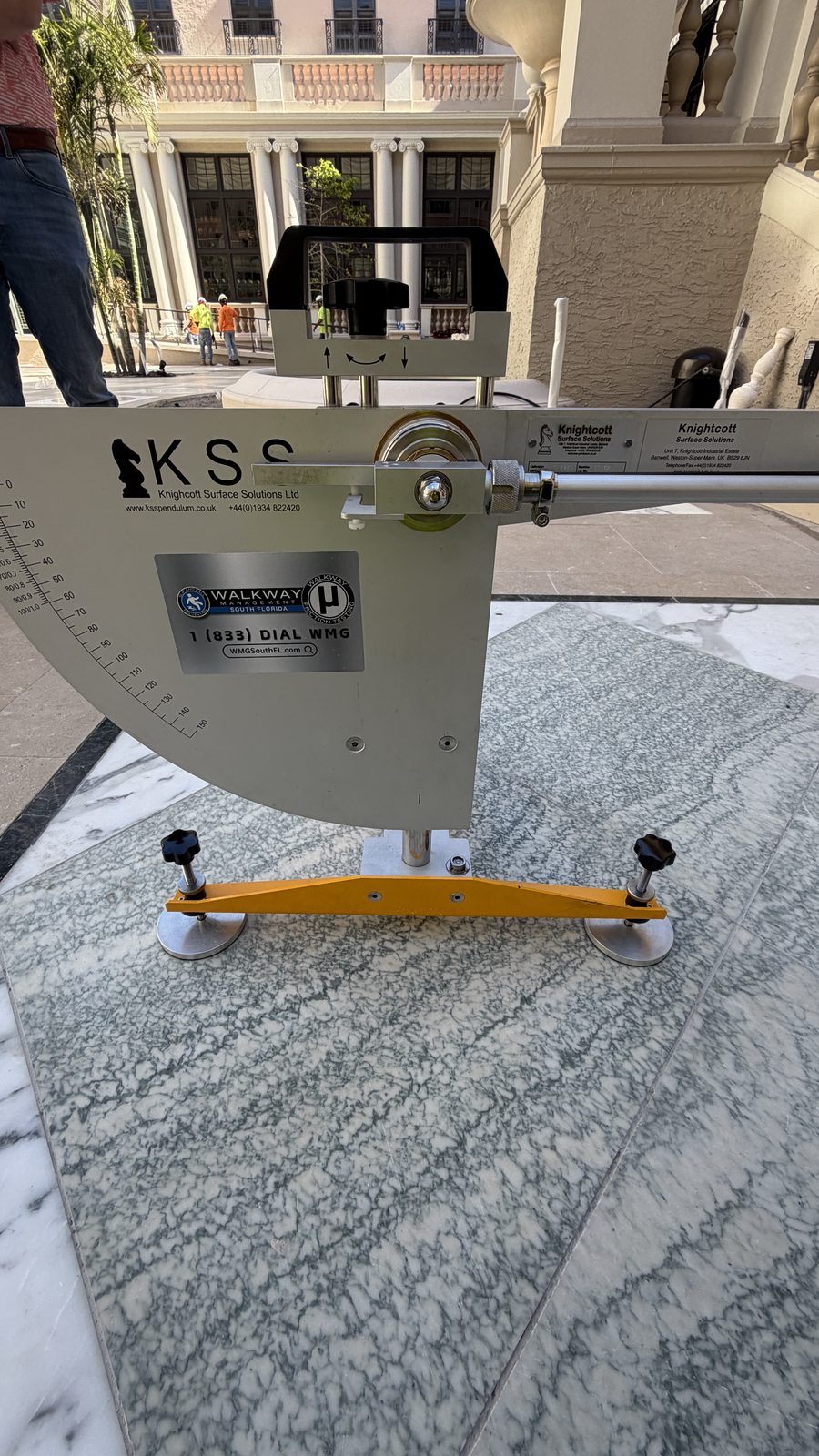
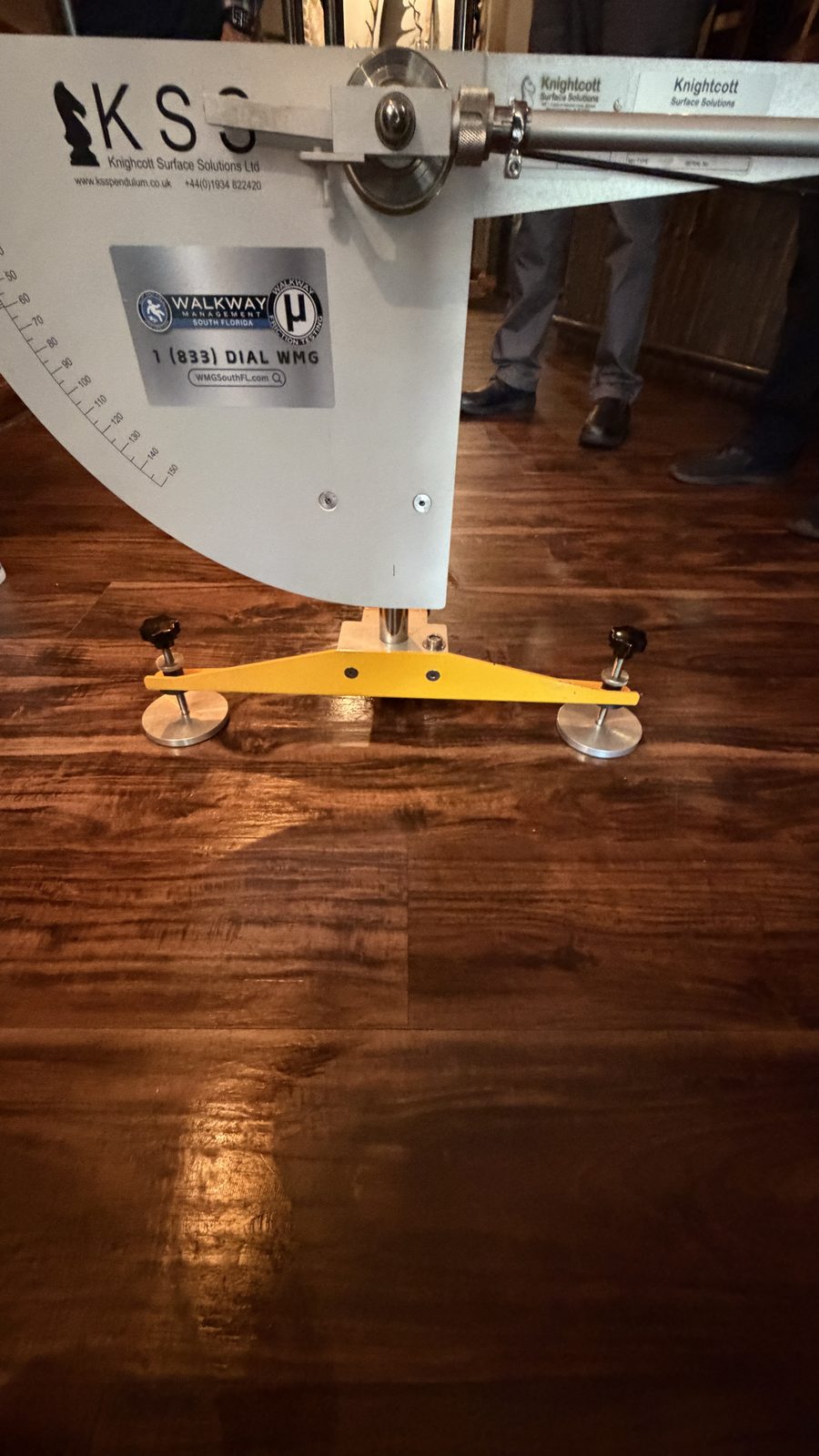
The pendulum on real floors.
Common questions
What’s the difference between PTV and BPN?
They’re the same measurement. PTV (Pendulum Test Value) is the current term; you may still see the older abbreviation BPN for the same number.
Is the pendulum better than a tribometer?
Neither one is better across the board. Each suits different surfaces: the pendulum excels outdoors and on textured floors, the BOT-3000E on smooth interior floors. We choose by surface, or run both.
Do you test pool decks with the pendulum?
Yes. Wet pool decks are an ideal pendulum application. See Pools & Aquatics.
Test the surfaces DCOF can’t.
The research behind pendulum testing
Pendulum (PTV) testing rests on decades of published slip research and a body of national and international standards. Selected sources:
- Health and Safety Executive (HSE), Assessing the slip resistance of flooring (GEIS2) — the PTV bands (0–24 high, 25–35 moderate, 36+ low slip potential) and the slip-probability basis (a wet PTV of 36 corresponds to roughly a 1-in-1,000,000 chance of a slip).
- ASTM E303-22, Standard Test Method for Measuring Surface Frictional Properties Using the British Pendulum Tester.
- Li, K.W., Chang, W.-R., Leamon, T.B., & Chen, C.J. (2004). Floor slipperiness measurement: friction coefficient, roughness of floors, and subjective perception under spillage conditions. Safety Science, 42(6).
- UK Slip Resistance Group (UKSRG), The Measurement of Floor Slip Resistance guidelines; and the pendulum classifications in CEN/TS 16165 (Europe) and AS 4586 (Australia).
Studies and standards are cited for reference. Consult the current published edition of any standard before making a compliance decision.