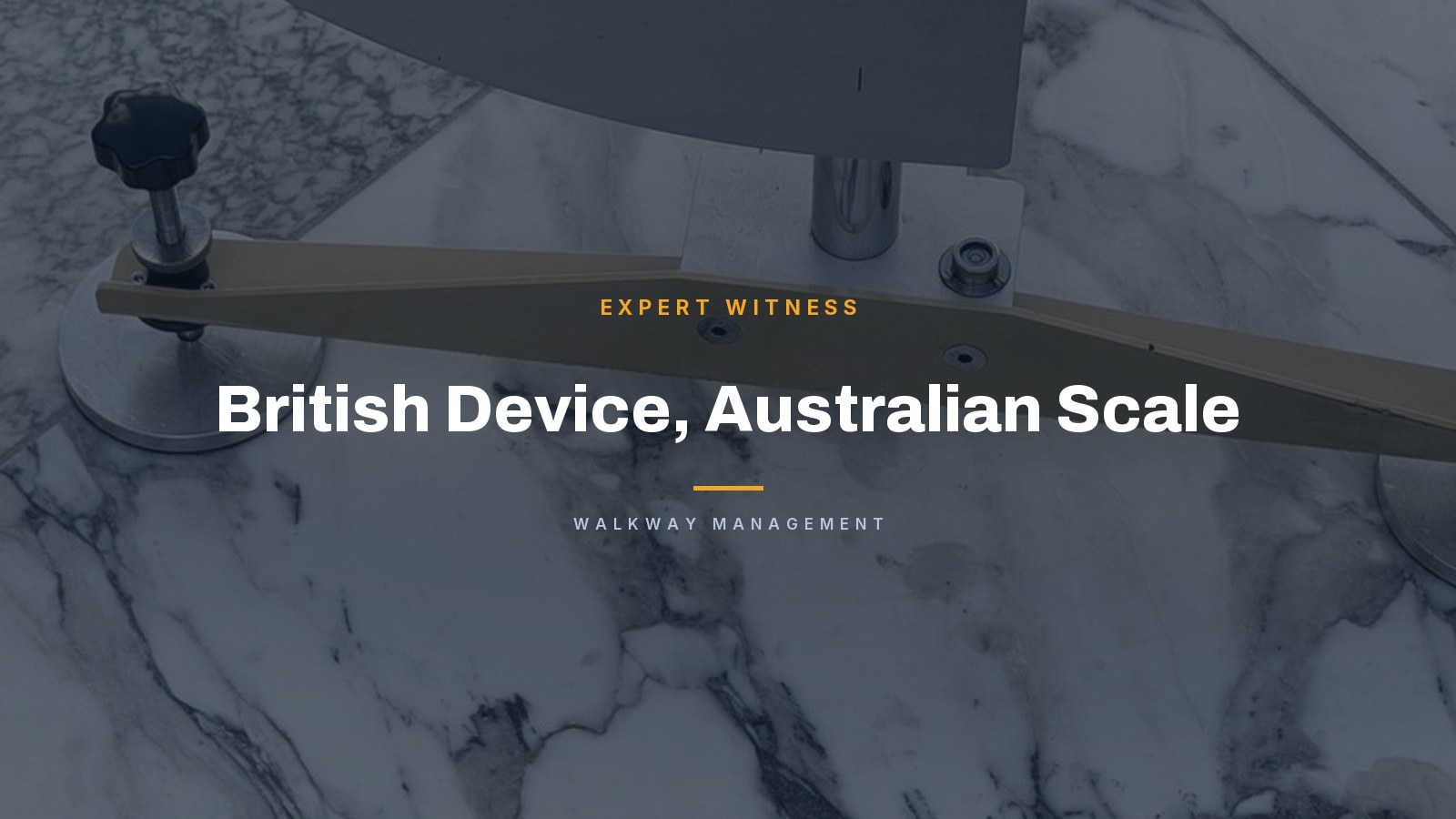
Why Your Expert Used a British Device and an Australian Scale
Instrument selection follows the failure mode, not the passport — and the objections that actually have teeth
The question comes in one of two forms.
The polite version: “Mr. Nan, can you explain to the jury why you relied on an Australian document to evaluate an American floor?”
The blunt version: “This accident happened in Florida. Why are you using British equipment and an Australian standard?”
Both are worth taking seriously, but they are not the same question, and answering one when you were asked the other is how a competent expert loses an exchange he should have won.
Two objections wearing the same suit
The first is a reliability challenge. Under Rule 702 — and its state analogues, whether the jurisdiction runs on Daubert or Frye — the question is whether the methodology rests on reliable principles and methods, reliably applied, and whether it enjoys general acceptance in the relevant technical community. That is a legitimate question. It deserves a technical answer.
The second is a provenance argument. It contains no scientific claim at all. It asks the jury to distrust a conclusion because of where the paperwork was printed. It is aimed at the gut, not the record.
An expert who responds to the reliability challenge with patriotic reassurance has conceded the science. An expert who responds to the provenance jab with fifteen minutes of tribometry has confirmed to the jury that he is hiding behind jargon. Identify which one you were asked.
The device in my hand is an American standard
The most useful thing to understand about the “British equipment” objection is that it is an objection to ASTM E303 — Standard Test Method for Measuring Surface Frictional Properties Using the British Pendulum Tester.
ASTM is an American standards developing organization. E303 is an American consensus standard. The pendulum was developed at Britain’s Transport and Road Research Laboratory, and ASTM adopted it, because that is what standards bodies do when a method works. ASTM incorporates ISO, EN, and national standards by reference as ordinary practice across dozens of committees. There is no separate, purer catalog of standards untouched by foreign science.
So counsel asking why an expert used “British equipment” is asking why the expert used an American standard test method. That is a fair thing to say out loud, once, calmly.
But stopping there would be a dodge, and it invites the follow-up that actually matters. E303 is a metrology standard. It tells you how to measure. It does not publish pedestrian risk classifications — it produces a British Pendulum Number, not a verdict. The number has to be interpreted against something, and E303 does not supply that something.
That gap is the real subject of the objection. It deserves a real answer.
The American catalog has a hole in it
The dominant American walkway-friction standard is ANSI A326.3, which measures wet dynamic coefficient of friction and sets a threshold of ≥0.42 for level interior wet spaces (≥0.55 for exterior and wet-plus classifications). It is a good standard. Within its scope it is the right tool, and I use it.
Its scope has boundaries that are frequently ignored:
- It is a shod-condition method, using a rubber sensor as a proxy for footwear.
- It wets the surface with a 0.05% sodium lauryl sulfate solution, modeling a re-emulsified cleaning-product film.
- It drags a motorized sled across the surface at 20 cm/s.
That last parameter is the one that matters here. A human heel strikes the floor at roughly 2.7 m/s — better than an order of magnitude faster. Under the squeeze-film model (Moore, 1972), the time required for a fluid layer to be displaced from the contact patch scales with contaminant viscosity and contact area against normal force. A sensor creeping at 20 cm/s has ample time to push the fluid out and measure something close to dry rubber on dry stone. A pedestrian does not. On polished stone and terrazzo, this produces the well-documented result of a surface passing a wet DCOF test while generating slip claims in the field.
Meanwhile ASTM D2047 and the James Machine measure static coefficient of friction, dry, with a leather sensor, on polish-coated flooring, in a laboratory. Applying it to a wet entryway is indefensible, and the standard itself does not ask you to.
Now the specific gap: no American standard publishes a pass/fail method for wet barefoot contact. Not A326.3. Not D2047. Not A1264.2.
Pool decks, shower rooms, locker rooms, splash pads and spa surrounds are among the highest-frequency wet-slip environments in the built world, and until very recently the American catalog addressed them with aspiration rather than measurement.
When the governing catalog contains no method for the condition that caused the incident, an engineer has three options. Use a method built for a different condition and hope nobody checks. Decline to measure and offer opinion instead. Or select the best-validated method that does address the condition, and disclose the selection reasoning.
Only the third is defensible. It is also, precisely, what Rule 702 asks for.
The adoption record
Here is where the provenance objection runs into trouble on the facts.
NSF/ANSI/CAN Standard 50 — the aquatic facility standard, developed under an ANSI-accredited process — evaluates aquatic surfacing using British Pendulum Number and the Australian P classification, alongside impact-attenuation criteria.
ASTM F2461 went further. For years, the standard’s guidance on aquatic decking amounted to five words: all decks should be slip-resistant. Well-intentioned, and unmeasurable. Unenforceable by a health inspector, unusable by a designer, and indefensible in a courtroom by either side.
Subcommittee F24.70 took that on. By the account of the task group chair, the work ran roughly five years and close to a dozen ballot cycles, and closed with zero negative votes. The task group began by reviewing existing devices and test methods to determine which were appropriate for the specific conditions of aquatic play — bare feet on wet surfaces. The chair of ASTM F13.10, the Traction subcommittee, participated in the technical work.
The result, published in the 2026 edition, specifies:
- the British Pendulum Tester, per ASTM E303
- Slider 55 (TRRL) rubber, the compound formulated for barefoot contact
- wetting with potable water
- performance at or above the P4 classification of AS 4586:2013
It also assigns responsibility along the chain: designers and manufacturers must supply guidance and documentation on cleaning, maintenance and validation; owner/operators must maintain and validate frictional performance and impact attenuation in accordance with it.
Decoded, the P4 classification is slider-dependent. With Slider 96 it spans 45–54 PTV. With Slider 55 it spans 40–44 PTV, with P5 above 44. The operative requirement is therefore approximately ≥40 PTV, Slider 55, wet.
That figure is worth sitting with, because three bodies working independently — an ANSI-accredited health-and-safety standard, an ASTM amusement-device subcommittee, and the published in-situ targets used by floor-safety practitioners for pool decks and communal shower rooms — converge on the same number for the same surface class.
Convergence across independent bodies is a stronger reliability signal than any single adoption. It is considerably stronger than the alternative on offer, which is a shod-condition drag sled applied to a barefoot surface because it happens to be domestic.
What this does not establish
An expert who overstates this precedent will be corrected in front of the jury, and the correction will cost more than the point was worth. Three limits:
Scope. F2461 is an F24.70 document governing aquatic play equipment. It is evidence that an American SDO evaluated the methods available for wet barefoot conditions and adopted this framework. It is not authority that AS 4586 governs a shod retail floor, a restaurant kitchen, or a hotel lobby. Those surfaces have their own analysis.
Timing. The 2026 edition is a 2026 document. Methodological reliability and standard of care are separate arguments. That a method is reliable and accepted today says nothing directly about what a property owner owed a plaintiff in 2021. Conflating them is an unforced error, and opposing counsel will be happy to do the conflating for you.
Depth. Adoption of a classification system for one surface class is not adoption of every threshold in the parent standard for every surface class. Cite what was adopted, not what you wish had been.
The objections that actually have teeth
If you intend to challenge an expert’s method — and both sides should — the following will do far more damage than nationality. They apply to me as readily as to anyone across the aisle.
1. Metric conversion. There is no valid conversion between PTV, DCOF, SCOF and BPN. They are different physical quantities produced by different contact mechanics at different velocities. An expert who converts between them — or who cites a conversion table — has produced a number with no physical meaning. This is the single most productive line of attack in walkway friction, and it has nothing to do with what country anything came from.
2. Slider compound. Slider 96 (Four S) models shod contact. Slider 55 (TRRL) models barefoot and rough outdoor surfaces. A pool deck evaluated with Slider 96, or an office corridor evaluated with Slider 55, is the wrong test regardless of how carefully it was run. Ask which compound. Ask why.
3. Conditioning protocol. This is the one most often missed. ASTM E303-22 conditions the slider on 60-grit silicon carbide cloth. BS 7976-2, AS 4663 and BS EN 16165 Annex C condition on P400 paper followed by wet pink lapping film. These produce materially different rubber surface states and are verified against different reference targets. Conditioning by one standard’s protocol and reporting against another standard’s classification bands is scientifically indefensible. Ask which protocol was used, what verification surface was read, and what value it returned.
This question also runs at the standards themselves. Where a document cites E303 for the device and AS 4586 for the threshold, practitioners need the governing text to state explicitly which conditioning protocol controls. Anyone relying on F2461’s 2026 language should read that clause directly rather than assume it.
4. Temperature. Slider 55 is strongly temperature-sensitive, with a reference band of roughly 18–23 °C. Readings taken outside it require documented correction. Outdoor testing in a hot climate, without surface-temperature logging and applied correction, does not produce a defensible number in either direction.
5. Contaminant. Potable water is the correct wetting agent for the standardized method. It is rarely the actual lubricant. On aquatic decks the real contaminants are sunscreen, body oils and biofilm. In commercial kitchens it is polymerized grease, where standard wet thresholds are invalid outright and both roughness and target values must rise substantially. Ask what was on the floor, and whether the test modeled it.
6. Device validation. ASTM F2508 exists to validate walkway tribometers against human slip data on reference surfaces. Whether an instrument tracks how people actually slip is a stronger reliability question than where it was manufactured — and it is the question Rule 702 is really asking.
7. Surface class and timing. Does the classification category match the actual use? Was the floor tested in the condition it was in at the time of the incident, or after refinishing, resealing, or a change in maintenance chemistry?
A method-selection framework
Four questions, answered in the report, in writing, before anyone is deposed:
- What was the contact condition — shod or barefoot?
- What was the contaminant, and what is its viscosity relative to water?
- Does an American standard publish both a method and a threshold for that exact condition? If yes, use it, and justify in writing any departure.
- If no, select the method validated for that condition, name the classification system and its parent standard by designation and edition, and state the selection reasoning on the page.
The last point carries more weight than experts tend to expect. An opinion whose method-selection logic was documented contemporaneously sits in a fundamentally different posture than one explained for the first time under cross-examination. The first reads as engineering. The second reads as improvisation, however sound the reasoning turns out to be.
The question behind the question
Counsel asking why an expert used a British device and an Australian scale is usually not making a claim about metrology. He is inviting the jury to substitute a feeling about provenance for an assessment of fit.
The answer is to decline the substitution:
I did not select an Australian standard. I selected the test method that measures the condition that caused this fall. The pendulum is specified in ASTM E303 — an American standard. Where American standards do not publish a threshold for that specific condition, I use the classification system that American standards bodies have themselves adopted for it. NSF/ANSI/CAN 50 did that. ASTM did it in F2461 in 2026.
That moves the argument from foreign versus American, which no expert wins in front of a jury, to does the method model the failure — which is the only question that was ever worth asking.
It cuts both ways, and it should. If the opposing expert’s method matches the failure mode, its national origin will not save your case. And if it doesn’t match, you will never need to mention Australia at all.
Sourcing and verification
Written for practitioners on both sides of the aisle. Standards evolve; verify designations, editions and thresholds against primary sources before relying on any of it in a report or deposition.
- ASTM F2461 (2026 edition) — the process history, participant accounts, and the four specified test parameters are drawn from published industry reporting rather than the standard’s text. The clause language, and specifically which slider conditioning protocol controls, should be read directly from the purchased standard before citation. At the time of writing, public catalog listings still showed F2461-23 as the most recent posted edition.
- AS 4586:2013 P classification bands — P4 as 45–54 PTV (Slider 96) and 40–44 PTV (Slider 55) should be confirmed against the current published table, including any amendments.
- NSF/ANSI/CAN Standard 50 — the BPN and P-classification criteria are reported second-hand and should be confirmed against the standard.
- ANSI A326.3, ASTM E303-22, ASTM D2047, ASTM F2508, BS 7976-2, AS 4663, BS EN 16165 — cited by designation for scope and method; confirm current editions.
- Squeeze-film model — Moore (1972). Tribometer validation against human slip data — Powers et al. (2010), the study underlying ASTM F2508.
Claudius Nan is the founder of Walkway Management South Florida, a slip-resistance testing and floor-safety firm, and serves as an expert witness in slip-and-fall matters for both plaintiff and defense. Disclosure: he operates a commercial floor-testing service and holds interests in slip-resistance testing products and data platforms – stated here because, as this article argues, disclosure is what makes a methodology piece usable by both sides. This is methodology guidance, not case-specific opinion.