
Surface Roughness Testing
The microscopic texture that
decides wet traction.
Wet slip resistance is won or lost at a scale you can’t see. Surface roughness testing measures the microscopic peaks and valleys that pierce a fluid film and keep a foot from hydroplaning.
From the field
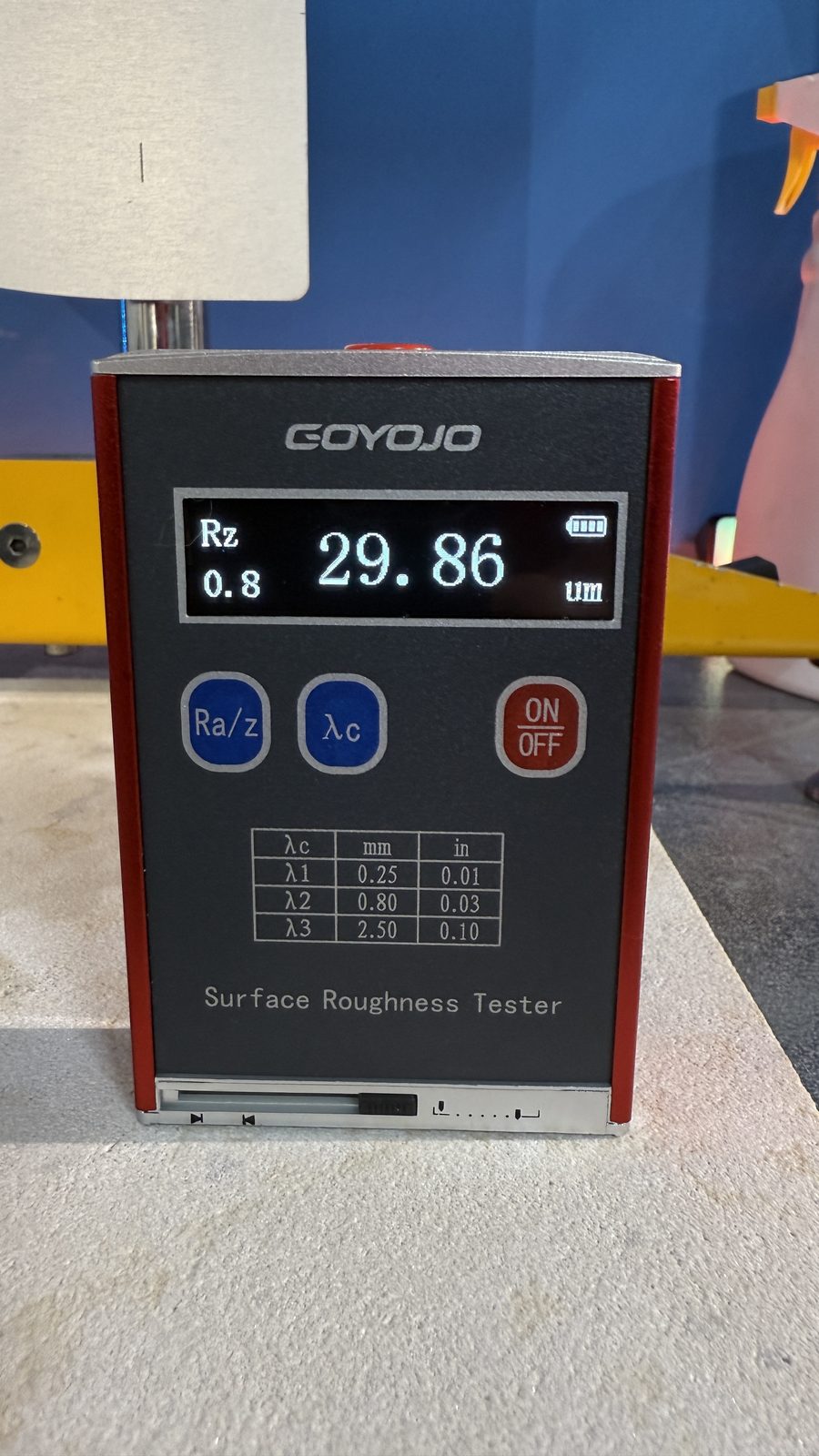
Measuring surface roughness.
What is surface roughness testing?
Surface roughness testing measures the microscopic texture of a floor — the peaks and valleys, called asperities — using a surface profilometer. It’s reported in parameters such as Ra (the average roughness) and peak-height measures like Rz and Rpm, expressed in microns. Where slip testing gives you a friction result, roughness testing tells you about the physical texture producing it.
Why roughness is the physics behind wet slips
When a shoe strikes a wet floor, it lands on a thin film of liquid. If that film can’t escape fast enough, the shoe hydroplanes on a pressurized layer of fluid and traction drops toward zero — the same effect that makes a car aquaplane. The only thing that defeats it is surface texture: microscopic asperities tall and sharp enough to pierce the film and make dry contact between sole and floor. Roughness testing measures exactly that texture, which is why it’s the most direct window into why a floor performs the way it does when wet — especially under grease and oil.
When surface roughness testing is the right tool
- Greasy environments — kitchens and food processing, where high-viscosity contaminants defeat ordinary wet thresholds and texture is everything
- Specifying or verifying a floor — confirm a surface has the texture to keep slip potential low under the expected contamination
- Verifying a traction treatment — measure that an etch or texturing treatment actually created the asperities it promised
- Wear and maintenance monitoring — detect when asperities are wearing down or filling with polymerized grease
- Forensic analysis — explain, physically, why an incident floor was slippery
Roughness plus slip testing
A PTV or DCOF result tells you how a floor performs; roughness tells you why, and whether that performance will survive real-world contamination and wear. For high-consequence surfaces — commercial kitchens, ramps, aggressive wet areas — reading them together turns a single measurement into an engineering understanding of the floor.
Common questions
Is roughness the same as slip resistance?
No — roughness measures texture, slip testing measures friction. Roughness explains and predicts wet slip performance, particularly under grease, but we pair it with slip testing rather than substituting for it.
Why does it matter most in kitchens?
High-viscosity contaminants like cooking grease are far harder to squeeze out from under a shoe than water. Only adequate surface texture defeats them, so roughness is the key measurement in greasy environments.
Can you verify my anti-slip treatment worked?
Yes — roughness testing before and after a treatment confirms whether it created the texture needed, alongside a slip re-test.
Understand your floor at the microscopic level.
The research behind roughness testing
Surface roughness (Ra) is the microscopic texture that pierces a fluid film and defeats hydroplaning, and its link to wet traction is one of the best-studied relationships in the field. Selected sources:
- Chang, W.-R. (1999). The effect of surface roughness on the measurement of slip resistance. International Journal of Industrial Ergonomics, 24(3).
- Li, K.W., Chang, W.-R., Leamon, T.B., & Chen, C.J. (2004). Floor slipperiness measurement: friction coefficient, roughness of floors, and subjective perception under spillage conditions. Safety Science, 42(6) — reports a strong correlation between Ra and wet/contaminated DCOF.
- Chang, W.-R., Hirvonen, M., & Grönqvist, R. (2004). The effects of cut-off length on surface roughness parameters and their correlation with transition friction. Safety Science — which roughness parameters best track traction.
- The adequate Ra depends on the contaminant: more viscous films (oils, grease) need more texture to keep traction, which is why roughness is most valuable in kitchens and greasy environments.
Studies and standards are cited for reference. Consult the current published edition of any standard before making a compliance decision.